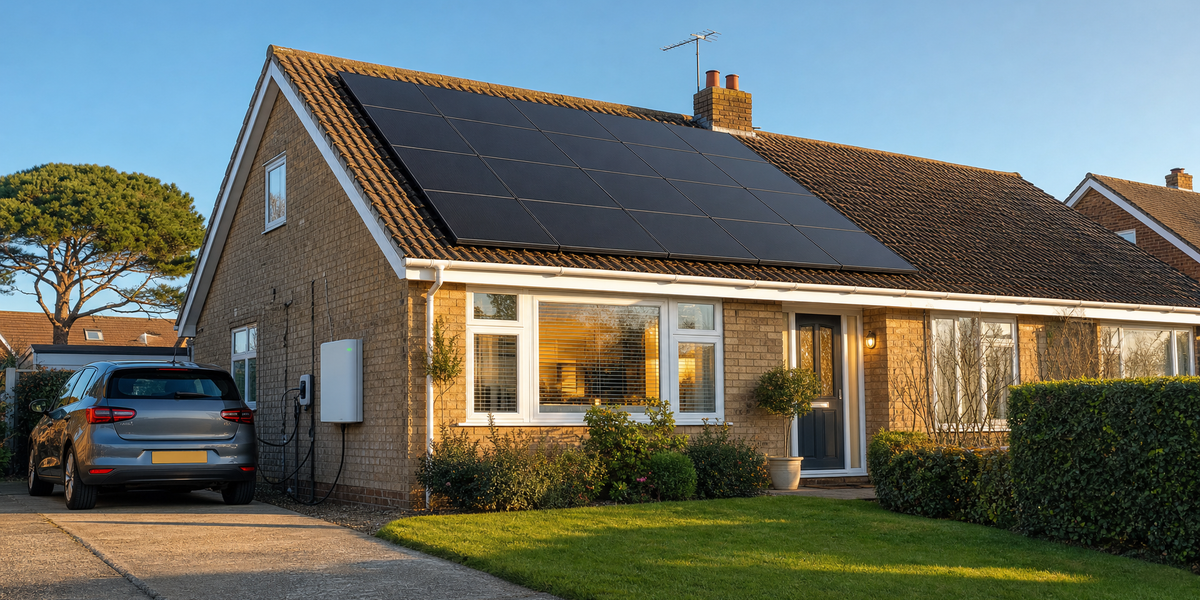
Energy Security and Solar Panels: Why South Coast Homeowners Are Better Placed
There has never been a better time to think seriously about energy security UK solar homes can offer. After years of volatile wholesale prices, geopolitical disruption to gas supplies and repeated changes to the energy price cap, the case for generating your own electricity at home has moved well beyond saving money on bills. For homeowners along the South Coast, from Bournemouth and Poole through to Southampton and Portsmouth, the picture is particularly encouraging. The combination of above-average sunshine hours, a strong local solar installation base and access to export payments means that a well-maintained solar system here does something that no energy tariff can: it puts you in partial control of your own supply.
What Energy Security Actually Means for a UK Homeowner
Energy security is a term that gets applied mostly to national policy discussions, but it has a very practical meaning at household level too. Put simply, it means reducing how exposed you are to factors outside your control, whether that is a spike in the wholesale gas price, a supplier going under or an Ofgem price cap review that pushes your standing charge upward again.
According to the Energy Saving Trust, a typical solar panel system in the UK can generate between 2,900 and 4,800 kilowatt hours per year depending on location and system size. On the South Coast, systems tend to sit toward the higher end of that range. That is electricity your household uses directly, electricity you do not pay the grid for, and in many cases electricity you can export back and get paid for through the Smart Export Guarantee.
The important thing to understand is that energy security is not about going off-grid entirely. Very few residential solar systems in the UK are set up that way. It is about reducing dependency, and that partial reduction has real financial and practical consequences.
Why the South Coast Has a Genuine Advantage
Solar output is directly tied to solar irradiance, and this is where geography genuinely matters. Met Office data consistently shows that the South Coast of England receives more hours of sunshine annually than almost any other part of the UK. Bournemouth, for instance, averages over 1,900 hours of sunshine per year, compared to the UK average of around 1,493 hours. That is not a marginal difference. It translates into meaningfully higher generation figures across the life of a system.
We have written before about why Bournemouth is one of the best places in the UK for solar, and the core argument remains the same: more sun means more generation, more generation means more self-sufficiency, and more self-sufficiency means less exposure to grid pricing.
There is also a practical point worth making about the coastal environment. Salt air along stretches of Dorset and Hampshire coastline can accelerate soiling and micro-corrosion on panels if they are not looked after properly. This does not diminish the advantage, but it does mean that maintenance matters more here than it might for an inland property. A system generating at 85 percent of its potential is still protecting you from the market, but a properly maintained system generating at 98 percent is doing a significantly better job of it.
Energy Security UK Solar Homes: How the Numbers Stack Up
Let us be direct about what the financial side of energy security looks like in practice. The Ofgem energy price cap has shifted repeatedly in recent years, and while the rate per unit has come down from its 2022 peak, it remains substantially higher than pre-crisis levels. A household consuming 3,500 kWh per year at current rates is spending well over a thousand pounds annually on electricity alone.
A 4kW solar system on a south-facing roof in Bournemouth or along the Hampshire coast can realistically generate 3,400 to 3,800 kWh per year. If around 40 to 50 percent of that is consumed directly within the home, the reduction in grid consumption is significant and immediate. The rest can be exported under the Smart Export Guarantee, generating a small but consistent income.
For those with older systems still registered under the Feed-in Tariff, the protection is even stronger. Those guaranteed payments continue regardless of what happens to market rates. If you are in that position, keeping the system in peak condition is essential to protecting that income. Our article on Feed-in Tariff systems in 2026 covers what you need to know to keep a legacy installation earning properly.
And for those considering battery storage alongside their panels, the calculation changes again. A home battery means you can store surplus daytime generation and use it in the evening, reducing grid dependency even further. We have covered this in detail in our guide to solar battery storage for South Coast homeowners.
The Role of Maintenance in Maintaining Energy Independence
This is where a lot of homeowners fall short. The solar panels on your roof are generating your energy security, and like any working piece of equipment, they need to be looked after. A system that has not been inspected or cleaned in three or four years is almost certainly not performing at its rated capacity.
There are several reasons output drops over time. Soiling from dust, bird droppings, moss and coastal salt deposits can reduce generation by 10 to 20 percent or more in worst cases. Inverter performance can degrade gradually without any obvious warning signs. Wiring connections can loosen. Mounting hardware can corrode. None of these things will necessarily trigger an alarm in your monitoring app, but they will quietly reduce what your system generates.
This is exactly what No1 Solar Care's Solar MOT service is designed to catch. Based in Bournemouth and operating across the South Coast, we carry out a thorough inspection of the panels, inverter, wiring and mounting structure, checking for anything that is reducing performance or creating a safety risk. It is the same principle as servicing a car: you would not run a vehicle for years without checking whether it is working properly, and the same logic applies to a solar system.
If you are unsure whether your system is performing as it should, a good first step is to take our 60-second solar health check, which can help identify whether a full inspection is warranted.
We have also written a detailed breakdown of why solar panels might not be generating enough power, which covers nine common causes that are easy to miss without a professional eye.
Salt Air, Coastal Weather and What It Means for South Coast Systems
One factor that is specific to properties along the Dorset and Hampshire coastline is the effect of salt-laden air on solar panels. This is not a problem that inland homeowners have to think about to the same degree, but it is a real consideration for anyone within a few miles of the coast.
Salt deposits on panel surfaces are not just a soiling issue. Over time, salt residue can etch into anti-reflective coatings and, in combination with moisture, can contribute to corrosion on aluminium frames and electrical contacts. This accelerates the natural degradation process that all panels go through and can mean a coastal system loses efficiency faster than its inland equivalent if it is not properly maintained.
Our article on how salt air damages solar panels on the South Coast goes into the detail of what this looks like and what the right maintenance response is. The short version is that regular professional cleaning and annual inspection are more important here than the manufacturers' guidance, which is typically written for average UK conditions rather than coastal ones.
Going Further: Battery Storage, EVs and a More Resilient Home
Energy security is not a fixed point. It is a spectrum, and there are practical steps that push a household further along it. Battery storage is the most significant one, allowing you to shift generation from midday to evening and reduce your dependence on the grid during peak pricing periods.
Pairing solar with an electric vehicle adds another layer. If you can charge your car from your own roof, you are insulating yourself from two volatile energy markets at once, petrol and electricity. Our guide to charging your electric vehicle with solar panels explains how this works in practice and what equipment you need.
For homeowners thinking about the longer picture, it is also worth knowing that solar panels add measurable value to a property. Evidence from the UK market suggests buyers are willing to pay a premium for homes with working, well-maintained systems. Solar Energy UK, the industry trade body, has published research supporting this, and we have covered the evidence in our article on whether solar panels add value to your home.
The key word in all of this is maintained. A solar system that has been neglected, where the inverter is ageing, the panels are soiled and no one has checked the wiring in years, does not offer the same financial or energy security benefits as one that is regularly looked after. This is why booking a professional Solar MOT inspection is not just about peace of mind. It is about making sure the investment you have already made is actually doing its job.
Grants, Incentives and Making the Most of What Is Available
For homeowners who do not yet have solar, or who are looking to upgrade an existing system, 2026 still offers meaningful financial support. The zero percent VAT rate on solar panel installations remains in place for now, though this will change in 2027. Our article on what the end of zero percent VAT actually means breaks down the real cost implications.
There are also grant schemes worth exploring, including those linked to the ECO4 framework and the Warm Homes Plan. For Dorset and Hampshire residents, our dedicated article on the Warm Homes Plan and what it means for local homeowners gives a clear picture of what is currently available and who qualifies.
If you are unsure whether you qualify for any current schemes, Citizens Advice provides free, independent guidance on energy grants and consumer rights, and is a useful first port of call before approaching a supplier or installer directly.
For those already installed, making sure your system is MCS certified and compliant is important if you want to access SEG payments or apply for any future grant funding. Non-compliant systems can be excluded from schemes even if they are generating well.
Frequently Asked Questions
What does energy security UK solar homes actually mean for my household?
It means reducing how much of your electricity comes from the national grid, and therefore how exposed you are to price rises and supply disruption. A solar panel system generating electricity from your own roof insulates you, at least partially, from wholesale market swings and Ofgem price cap changes that affect grid-connected homes fully.
Are South Coast homes genuinely better placed for solar energy security?
Yes, meaningfully so. The South Coast, including Bournemouth, Poole and much of Dorset and Hampshire, receives significantly more sunshine hours than the UK average. This translates into higher annual generation, greater self-consumption and stronger energy independence compared to systems installed further north.
How does a Solar MOT help with energy security?
A Solar MOT from No1 Solar Care identifies anything that is reducing your system's output, from dirty panels and failing inverters to loose wiring and mounting corrosion. A system generating at full capacity provides much stronger protection against grid dependence than one quietly underperforming. You can learn more and book via the Solar MOT service page.
Does battery storage significantly improve energy security for South Coast homeowners?
It does. Battery storage allows you to use solar-generated electricity in the evening rather than buying from the grid at peak times. Combined with a well-maintained panel system, it can reduce grid consumption by 60 to 80 percent in summer months, which makes a substantial difference to both bills and energy independence.
How does salt air on the South Coast affect my system's ability to provide energy security?
Salt deposits reduce panel output by blocking light and, over time, can cause frame and contact corrosion. Both effects reduce what your system generates, which in turn reduces the protection it offers against grid prices. Regular professional cleaning and annual inspection matter more in coastal areas of Dorset and Hampshire than the standard manufacturer guidance suggests.
What government incentives are currently available to support solar energy security?
The Smart Export Guarantee pays you for surplus electricity exported to the grid. Zero percent VAT on solar installations remains available until 2027. Grant support through the Warm Homes Plan and ECO4 scheme may also be accessible depending on your circumstances. Each of these strengthens the financial case for going solar or upgrading an existing system.
How do I know if my existing solar system is still working well enough to provide real energy security?
The best starting point is to compare your current generation figures against your system's original performance estimates. If there is a significant gap, or if you have never had a professional inspection, that is a clear sign to act. You can start with our 60-second solar health check or go straight to booking a full inspection.
Book your Solar MOT today. Call 01202 023069 or visit no1solarcare.co.uk/solar-mot