How Salt Air Damages Solar Panels on the South Coast (And What to Do About It)
How Salt Air Damages Solar Panels: A South Coast Owner's Guide
Most solar panel owners on the South Coast know the sea is close. What many do not realise is that the sea is actively working against their solar investment every single day, whether they can see it or not.
Salt particles from the English Channel travel further inland than most people expect. They settle on panel glass, corrode aluminium frames, and attack electrical connections in ways that standard inland maintenance schedules simply do not account for. The result is accelerated degradation, reduced output, and in some cases voided manufacturer warranties.
This guide explains exactly what salt air does to solar panels, how to identify the early warning signs, and what South Coast homeowners can do to protect their system. If your panels are within 10 miles of the coast, which includes most of Bournemouth, Poole, Christchurch, and stretches of Hampshire, this applies directly to you.
In summary: salt air from the English Channel deposits corrosive sodium chloride particles on solar panels year-round. Left untreated, this reduces panel efficiency by up to 6% and accelerates frame corrosion that standard warranties do not cover.
Why the South Coast Is a High-Risk Environment for Solar Panels
The English Channel generates salt-laden air that travels several miles inland on a regular basis, particularly during onshore winds. The Met Office records prevailing south-westerly winds along the South Coast for much of the year, driving sea air directly over Bournemouth, Poole, and the surrounding areas.
This is not a minor environmental factor. International solar panel testing standards recognise coastal environments as a distinct category. The IEC 61701 standard covers salt mist corrosion resistance in solar panels, and it exists for a very specific reason: salt is genuinely damaging to photovoltaic systems in ways that rain and standard weather are not.
What makes coastal solar maintenance different from inland maintenance is the cumulative, invisible nature of the damage. Salt does not announce itself. It builds up gradually, causes corrosion at connection points before any visual sign appears, and quietly reduces your system output month by month.
The key point: proximity to the coast is not just a lifestyle factor. It is a material consideration for solar panel maintenance. A system 500 metres from the seafront faces a fundamentally different maintenance requirement than one 20 miles inland.
What Salt Air Actually Does to Solar Panels
There are four distinct ways that salt air damages a solar system. Understanding each one helps explain why coastal maintenance needs to be more frequent and more thorough than the standard once-a-year clean.
1. Surface Soiling and Light Transmission Loss
Salt particles that land on panel glass do not wash off cleanly in rain. They bond to the surface and form a residue that ordinary rainfall does not fully remove, particularly on panels installed at the shallow angles common in UK residential properties. This residue reduces the amount of sunlight reaching the photovoltaic cells underneath.
Research into coastal soiling has found that losses in seaside environments can reach 4 to 6 percent annually, compared to 1 to 2 percent in clean inland locations. On a 4kW system in Bournemouth generating around 4,000 kWh per year, a 6% soiling loss represents approximately 240 kWh of lost electricity, worth around £70 to £80 at current rates, every year.
The loss compounds over time. A panel that has never been properly cleaned in a coastal environment may be operating at 85 to 90 percent of its rated output without a single fault appearing on the inverter display. If your output has been dropping without explanation, a free 60-second solar health check is a quick way to find out whether it warrants a closer look.
2. Frame and Mounting Corrosion
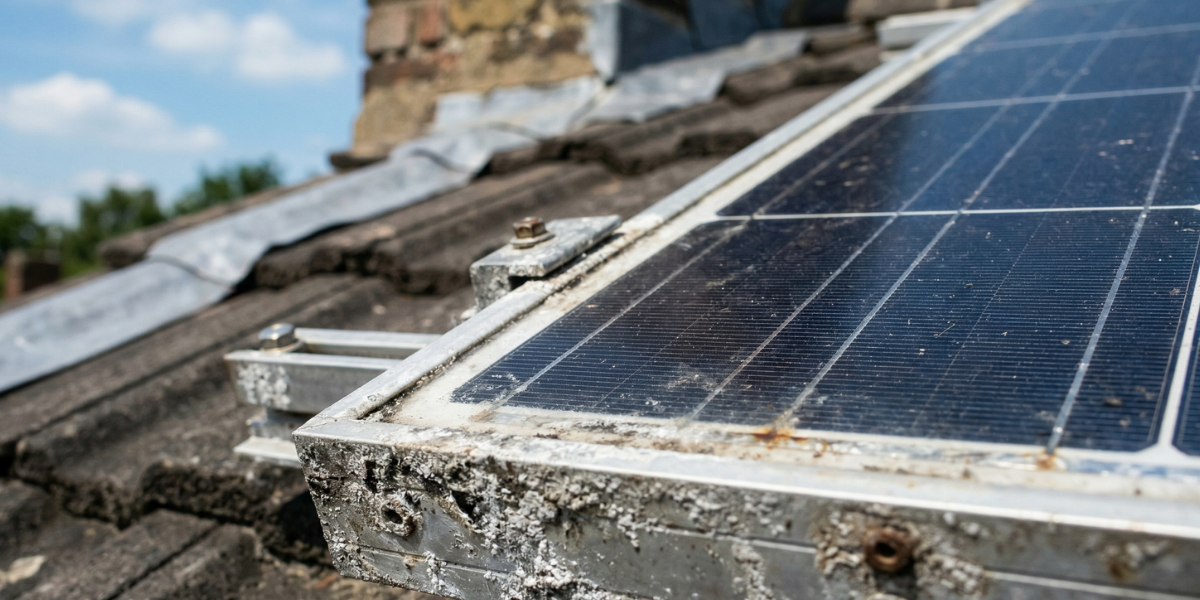
Solar panel frames are typically made from anodised aluminium, which resists standard weathering well. But prolonged exposure to salt air gradually breaks down the anodised layer, particularly at joints, fixings, and anywhere the surface was scratched during installation or maintenance.
Once the protective layer is compromised, the underlying aluminium oxidises. This process accelerates in the presence of moisture and salt, exactly the conditions found on the South Coast in autumn and winter. Corroded frames can affect the structural integrity of the panel mounting, create galvanic corrosion where dissimilar metals meet, and in advanced cases allow water to get into the panel laminate itself.
We regularly inspect South Coast systems where mounting brackets show significant surface rust within 5 to 7 years of installation. Not because the components were low quality, but because they were specified for standard inland conditions rather than a coastal marine environment.
3. Electrical Connection Degradation
This is the least visible and potentially the most costly form of salt air damage. The DC connections between solar panels, and between panels and the inverter, are housed in junction boxes designed to be weatherproof. But weatherproof is not the same as salt-proof over an extended period.
Salt is conductive. When it gets into connection points through micro-gaps in weatherproof seals that degrade over time, it can cause arc faults, increased resistance, and in serious cases a fire risk. Coastal properties where salt accelerates seal degradation face this risk earlier than inland systems. An annual electrical inspection that specifically checks DC isolators, junction box integrity, and cable insulation is not optional for South Coast homeowners. It is included as standard in No1 Solar Care's Solar MOT.
4. Inverter Ventilation Contamination
Inverters are typically installed in loft spaces or on external walls, and they rely on ventilation to manage operating temperatures. In coastal properties, this ventilation draws in salt-laden air that gradually deposits on internal components. Over time this contributes to overheating, component degradation, and premature inverter failure.
Industry data shows that around half of all inverters develop significant faults within 14 years on average. In coastal environments with additional salt contamination, the timeline towards failure can be shorter. If your inverter is more than 8 years old and has never been serviced, particularly if you are within a few miles of the coast, it deserves a proper look.
How Far Inland Does Salt Air Travel?
This is the question most South Coast homeowners ask first. The honest answer is further than most people assume, and the distance varies considerably depending on wind conditions.
Studies of coastal salt deposition consistently show measurable saltfall at distances of 10 to 15 kilometres from the shoreline under typical conditions. During sustained onshore winds, which are common on the South Coast between October and March, salt particles can travel significantly further. Properties in areas like Wimborne, Ferndown, and Ringwood, which most people would consider comfortably inland, can still be affected during prolonged south-westerly weather.
As a practical guide, properties within 500 metres of the coast face high risk. Professional cleaning every 3 to 4 months is advisable, with an annual electrical inspection. Between 500 metres and 2 kilometres, the risk remains elevated. Cleaning every 6 months as a minimum is sensible, with an annual inspection. From 2 to 10 kilometres, the risk is moderate. Annual cleaning is likely sufficient, but an annual inspection should specifically check for salt-related corrosion. Beyond 10 kilometres, a standard inland maintenance schedule is generally appropriate, though local geography and wind patterns both play a role.
If you are unsure which category your property falls into, the simplest test is to run your finger along a panel frame after a dry week. A white or grey powdery residue is salt accumulation.
Warning Signs That Salt Air Is Already Affecting Your System
Salt damage often develops for months or years before it becomes obvious. These are the indicators worth looking out for.
White or Grey Powdery Deposits on Frames
The most visible sign of salt accumulation. This residue typically appears at the corners and edges of panel frames and around mounting brackets. It looks similar to limescale but is lighter and more powdery. Left in place, it marks the start of the corrosion process.
Pitting or Discolouration on Aluminium Frames
Small pits or darker patches on the frame surface indicate the anodised coating has been compromised and corrosion has begun. At this stage the structural integrity of the frame is likely still intact, but action is needed before it progresses.
Output Drop That Cannot Be Explained by Season
If your monitoring app or generation meter shows a drop in output that does not correspond to seasonal variation or obvious shading, surface soiling from salt accumulation is one of the most common explanations. A system producing 8 to 10 percent less than expected in summer, when output should be at its peak, warrants investigation.
Rust or Staining Around Roof Fixings
Visible rust staining running down from mounting points is a sign that steel fixings are corroding. This can indicate the system was not specified for coastal conditions during installation, and suggests the structural security of the mounting should be checked professionally.
Inverter Errors or Isolation Faults
Isolation faults on the inverter display, often shown as an error code rather than a written message, can indicate compromised wiring insulation or connection integrity. In a coastal context, salt contamination of junction boxes is a possible cause. These should be investigated by a qualified engineer, not simply reset.
What South Coast Homeowners Should Do
The systems that degrade fastest are those that receive standard inland maintenance on a coastal property. With the right approach, a South Coast solar system can perform reliably for its full intended lifespan.
Increase Cleaning Frequency
The standard MCS guidance recommends professional solar panel cleaning once or twice per year. For coastal properties, once a year is not sufficient. Within 2 kilometres of the shoreline, cleaning every 3 to 6 months is more appropriate. This is not about keeping panels looking presentable. It is about preventing salt residue from bonding to the glass surface to the point where it becomes difficult to remove without abrasion.
Professional cleaning uses purified water systems that remove salt deposits without leaving mineral residue. DIY cleaning with tap water can actually make things worse on properties with hard water, as the minerals in tap water add a further layer of contamination when it evaporates.
Annual Electrical Inspection
A visual clean is not the same as a system inspection. Every South Coast solar installation should receive an annual professional inspection that specifically checks DC isolator condition, junction box seal integrity, cable insulation, and mounting hardware corrosion. It is the kind of inspection that catches developing faults before they become expensive failures.
The MCS recommends regular maintenance and inspection as part of good system stewardship. Documented maintenance records also protect warranty claims. Most panel manufacturers require evidence of professional upkeep to honour performance warranties.
Specify IEC 61701 Certified Components When Replacing Parts
If you are replacing panels, an inverter, or mounting hardware on a coastal property, ask for components certified to IEC 61701 salt mist corrosion resistance standards. Not all panels carry this certification, and for properties within a kilometre or two of the sea it makes a meaningful difference to long-term durability.
Book a Solar MOT If You Have Not Had One
If your panels have been running for more than two or three years without a professional inspection, or if you have moved into a property with an existing solar system and do not know its history, a Solar MOT gives you a baseline assessment of system condition. It includes a visual inspection of all components, inverter diagnostics, electrical safety checks, and a written report grading any findings by urgency.
For South Coast properties specifically, we carry out an additional check for early-stage frame corrosion and junction box seal condition that is not part of a standard inland inspection. There is no obligation to proceed with any recommended work.
Frequently Asked Questions
Does rain wash salt off solar panels?
Not reliably. Rain removes some surface dust and loose particles, but salt residue forms a stronger bond with glass than ordinary dirt and is not fully removed by rainfall alone. Rain can actually redistribute salt rather than washing it away, and as water evaporates it concentrates remaining salt at the edges of droplets. Professional cleaning with purified water is needed to properly remove accumulated salt.
How do I know if my solar panels are IEC 61701 certified?
The IEC 61701 certification should appear on your panel datasheet, which was provided at installation. If you do not have your installation paperwork, the panel model number is usually printed on a label on the back of each panel. Your installer or the panel manufacturer can confirm certification status from that number.
Can salt air void my solar panel warranty?
Salt air itself does not void a warranty. However, failing to maintain panels properly in a coastal environment, and failing to document that maintenance, can lead to warranty claims being rejected if a manufacturer argues that corrosion damage resulted from inadequate maintenance rather than a product defect. Keeping records of professional cleaning and inspection protects you against this.
How often should coastal solar panels be professionally cleaned?
Within 500 metres of the coast, every 3 to 4 months. Between 500 metres and 2 kilometres, every 6 months. Beyond 2 kilometres, annual cleaning is likely sufficient, though the specific location, panel angle, and local wind patterns all affect the rate of salt accumulation.
Is my property at risk if I cannot see the sea?
Yes, potentially. Salt particles are carried by wind, not just proximity. Properties several kilometres from the shoreline can experience significant saltfall during sustained onshore weather. If you are within 10 kilometres of the South Coast and your panels face south or south-west, the direction of prevailing onshore winds, your system is likely affected to some degree.
What is the difference between a standard solar panel clean and a coastal inspection?
A standard clean focuses on removing surface soiling. A coastal inspection goes further: checking frame condition for early corrosion, examining mounting hardware for rust or galvanic corrosion, testing junction box seals, and assessing DC cable insulation integrity. No1 Solar Care's Solar MOT includes all of these as standard for South Coast properties.
The Bottom Line
Living on the South Coast is one of the best positions in the UK for solar energy production. Bournemouth receives more sunshine hours than almost anywhere else in England, and the financial returns from a well-maintained system are genuinely significant. But the same coastal environment that gives you that sunshine also creates a maintenance challenge that the solar industry has been slow to address.
The systems that underperform are not usually poorly installed or made from inferior panels. They are systems that received standard inland maintenance on a coastal property. Good enough for Birmingham, but not good enough for Bournemouth.
If your panels are within reach of the English Channel and have not had a proper coastal-specific inspection, there is a reasonable chance they are already producing less than they should. A Solar MOT is the starting point. It tells you exactly where things stand and what, if anything, needs attention.
Book your Solar MOT today. Call 01202 023069 or visit no1solarcare.co.uk/solar-mot