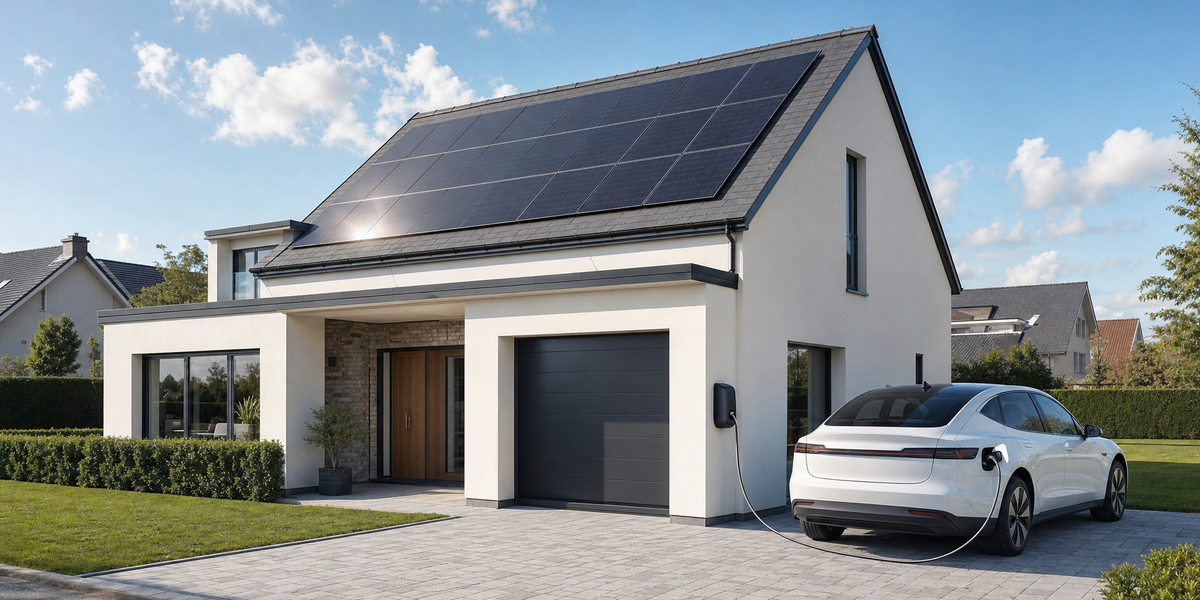
Charging Your Electric Vehicle with Solar Panels
If you own an electric vehicle and already have solar panels on your roof, or you're thinking about getting both at once, you're in a position that most UK households would genuinely envy. Combining an EV charger with solar panels at home in the UK can cut your motoring costs dramatically, reduce your dependence on the grid, and turn daylight into miles. This guide walks through how the whole setup works, what you need to get right, and why keeping your solar system in good shape is just as important as buying the right charger.
How EV Charger Solar Panels Work Together at Home in the UK
The basic principle is straightforward. Your solar panels generate DC electricity, the inverter converts it to AC, and that AC power flows around your home exactly like electricity from the grid. When your EV charger is plugged in and your panels are generating, the car draws from your solar output first before pulling anything from the grid.
The key to making this work properly is timing. Most home EV chargers, particularly smart chargers, can be set to charge during daylight hours when your panels are producing. If you want to go further and maximise self-consumption, pairing your solar array with a battery storage system allows you to bank surplus generation during the day and charge your vehicle in the evening. Whether battery storage is worth the investment is a question we've looked at in detail separately, but for EV owners specifically, the case is often stronger than for households without a car to charge.
Smart Chargers and Solar Diverters
A solar diverter is a device that monitors your home's electricity flow in real time and redirects surplus generation to whatever appliance you point it at. Many EV owners use them specifically to top up their car battery during the day rather than exporting that surplus to the grid at a low rate. Smart chargers with built-in solar integration, such as those from brands like Ohme, Zappi or Indra, do much the same thing but with more control via an app.
The Smart Export Guarantee means you'll still get paid for any surplus you export, so it's not a case of using every last unit for the car or losing money. It's more about finding the right balance between personal use and export income based on your own driving habits and tariff rates.
What UK Solar Generation Actually Delivers for an EV
A typical electric vehicle needs roughly 3 to 4 miles of range per kilowatt-hour of electricity. A 4kW solar panel system on a well-oriented UK roof can realistically generate 3,200 to 4,000 kWh in a good year, with the higher end achievable in southern parts of the country and the lower end more typical further north. That's enough to cover a substantial share of average annual mileage, depending on how much of the generation you capture for your car versus export to the grid.
Met Office data shows meaningful regional variation in annual sunshine hours across the UK, but the difference is smaller than most people assume, and it doesn't change the fundamentals. Solar panels generate from daylight rather than direct sunshine, which means EV charging from solar is viable across the whole country, not just in the sunniest counties.
Sizing Your Solar System for EV Charging
If you're starting from scratch and planning to install solar primarily with EV charging in mind, you'll want to think about system size more carefully than someone just trying to cut their household electricity bill.
A modest 3kW system might cover your household usage comfortably during summer but leave little surplus for the car. A 5kW or 6kW system gives you considerably more headroom and will generate meaningfully more across the year on a roof with good south-facing orientation. The Energy Saving Trust recommends thinking about your total household electricity demand, including any new loads like an EV, before settling on array size.
Roof space is obviously a constraint. Modern panels are more efficient than those installed ten years ago, so if you're adding panels to an existing array or replacing older ones, you may be able to fit more generation capacity in the same footprint. Solar panel degradation is also worth understanding here: panels lose a small percentage of their output each year, typically around 0.5% annually for quality modules, so an older system may be generating noticeably less than its rated capacity.
Does Your Roof and Grid Connection Support It?
For larger solar arrays designed to support EV charging, your Distribution Network Operator may need to approve the installation, particularly if you're going above 3.68kW single-phase output. Your installer should handle this as part of the process, and any system installed by an MCS-certified company will meet the standards required for grid connection approval and for claiming Smart Export Guarantee payments.
It's also worth checking whether your home's electrical consumer unit can support both a new solar system and a dedicated EV charger circuit. An electrician or solar installer should assess this during the survey stage.
Getting the Most from a System You Already Have
Many UK homeowners already have solar panels installed and are now adding an EV to the household. In that case, the first priority is making sure your existing system is actually performing as it should. There's no point in routing your EV charging through your solar panels if those panels have degraded significantly, have dirty glass reducing output, or have an inverter that's losing efficiency.
This is where a Solar MOT becomes genuinely useful. No1 Solar Care's Solar MOT service covers a full inspection of your panels, wiring, inverter, mounting and output data to identify anything that might be dragging down your generation. If you've noticed your system isn't producing what it used to, or you've never had it checked since installation, getting an inspection done before you start relying on it to charge a car is a sensible move.
Homes near the coast face specific challenges. Salt air accelerates the corrosion of mounting hardware and connectors, and grime from coastal air and traffic pollution builds up on panel surfaces faster than in inland areas. Salt air damage is a real and underappreciated issue for anyone living within a few miles of the sea, and it's one of the main reasons routine inspection matters more in those areas.
Inverter Performance and EV Charging
Your inverter is the heart of your solar system. If it's underperforming or starting to develop faults, your EV charging efficiency will suffer whether you notice it on your monitoring app or not. Common symptoms include output figures that don't match expected generation for the conditions, error codes appearing intermittently, or the system cutting out during peak generation hours.
Inverter problems are more common than most homeowners realise, and they're often the first component to need attention on systems that are more than eight to ten years old. If you're planning to lean harder on your solar system because of an EV, having the inverter checked as part of a professional inspection is time well spent.
The Financial Case: What You Can Actually Save
Running a car on solar-generated electricity rather than grid electricity represents a meaningful saving over time. At current energy prices, the cost difference between charging from the grid at peak rates versus charging from your own solar generation can be substantial over the course of a year.
The Ofgem price cap has made grid electricity more expensive for millions of households, and while rates fluctuate, the underlying trend over the past several years has been upward. Solar-generated electricity costs you nothing at the point of use, so every mile you drive on sunshine rather than grid power is a genuine saving. We've written about how the energy price cap affects solar owners and why those with well-maintained systems are considerably better insulated from price rises.
For households with a good-sized array, a smart charger, and perhaps a battery, it's realistic to cover a significant proportion of annual EV charging from self-generated solar. Exact figures depend on your driving mileage, panel orientation, system size and how well your panels are maintained.
Maintenance: The Step Most EV and Solar Owners Skip
Here's the thing that doesn't get discussed enough. People spend considerable time researching which EV to buy and which charger to install, then completely overlook the condition of the solar system that's supposed to power everything. A poorly maintained array won't generate anywhere near its potential, and that gap between actual and potential output is money that should be in your pocket rather than lost to dirt, degradation or faults.
The financial cost of neglecting solar panel maintenance is well documented. Output losses from dirty panels alone can reach 15 to 25% in particularly grimy conditions, and that figure climbs when you add in undetected faults or inverter issues. For an EV owner relying on solar generation, that translates directly into more grid electricity purchased and lower savings.
Professional cleaning is part of the answer. Beyond cleaning, a proper annual inspection through our Solar MOT service catches the kinds of issues that cleaning alone won't resolve: loose connections, microcracks in cells, failing bypass diodes, or mounting hardware that's beginning to corrode.
If you're not sure where your system stands right now, the quickest starting point is our free 60-second solar health check, which gives you an immediate sense of whether your system needs attention.
Grants, Incentives and What to Claim
If you're installing solar panels and an EV charger together, there are financial incentives worth knowing about. VAT on residential solar installations is currently set at zero percent, as confirmed by HMRC guidance on VAT for energy saving materials, which reduces the upfront cost compared to what it was before 2023.
The Smart Export Guarantee means you'll earn money for surplus electricity you don't use yourself, including surplus that isn't needed for EV charging on a given day. Getting the best export rate requires shopping around between energy suppliers, as rates vary considerably. Our guide to Smart Export Guarantee payments and how to get the best rate covers this in detail.
For lower-income households, schemes like ECO4 may offer routes to funded solar installation. It's worth checking eligibility if you haven't yet installed panels. Citizens Advice can help if you're unsure whether you qualify for any current support scheme.
Where No1 Solar Care Works
We install, maintain and repair solar systems across two regions. In South Wales we cover Cardiff, Newport, Swansea and the surrounding areas. On the South Coast we cover Bournemouth, Poole, Southampton and across Dorset and Hampshire.
If you're in either region and planning to pair an EV with your solar system, a professional inspection first is the sensible order of events. Get the generation right, then build the charging setup on top of it.
Frequently Asked Questions
Can I charge my EV directly from solar panels at home in the UK?
Yes. With a compatible smart EV charger or solar diverter, your car can draw directly from your solar panels' output during daylight hours. A smart charger set to prioritise solar generation will automatically use what your panels produce before pulling from the grid, reducing your charging costs significantly when the sun is out.
How many solar panels do I need to charge an electric car?
It depends on your car's battery size and how many miles you drive. As a rough guide, a 5kW solar system generating around 4,000 to 4,500 kWh per year could theoretically provide enough electricity for 13,000 to 18,000 miles of EV driving annually, though you'll also need some of that generation for household use.
Do EV charger solar panels work well in UK weather?
Absolutely. Solar panels generate electricity from daylight, not direct sunshine, so they still produce on overcast days. UK homes across the country generate enough to make EV charging from solar worthwhile, and while southern regions have a modest edge on annual sunshine hours, the difference is smaller than most people expect.
Should I get a battery storage system alongside my solar and EV charger?
For EV owners, battery storage is often more worthwhile than for households without a car to charge. A battery lets you store surplus daytime generation and use it for evening charging rather than exporting it at a low rate. Whether the numbers add up for your specific situation depends on your usage patterns, tariff and system size.
How often should I have my solar panels inspected if I'm using them to charge an EV?
At least once a year, ideally before the summer when generation peaks and your EV charging potential is highest. An annual Solar MOT will catch any faults, degradation or dirt-related losses that could be quietly reducing how much electricity your system is actually producing for your car and your home.
Will adding an EV charger affect my Smart Export Guarantee payments?
Not directly. Your SEG payments are based on what you export to the grid, and using more of your generation for EV charging simply means you export less. You won't lose your SEG entitlement, but your export income will naturally decrease as self-consumption rises. Whether that trade-off works in your favour depends on your current export rate versus your grid import tariff.
Is it worth getting solar panels specifically to charge an EV if I don't have them yet?
For most UK homeowners, yes. The combination of lower motoring costs, reduced household electricity bills, Smart Export Guarantee income on surplus power, and zero VAT on installation makes a compelling financial case. Speaking to an MCS-certified installer is the right starting point to understand what your specific roof and usage profile would generate.
Book your Solar MOT today. Call 01202 023069 (South Coast) or 029 2002 6002 (South Wales), or visit no1solarcare.co.uk/solar-mot