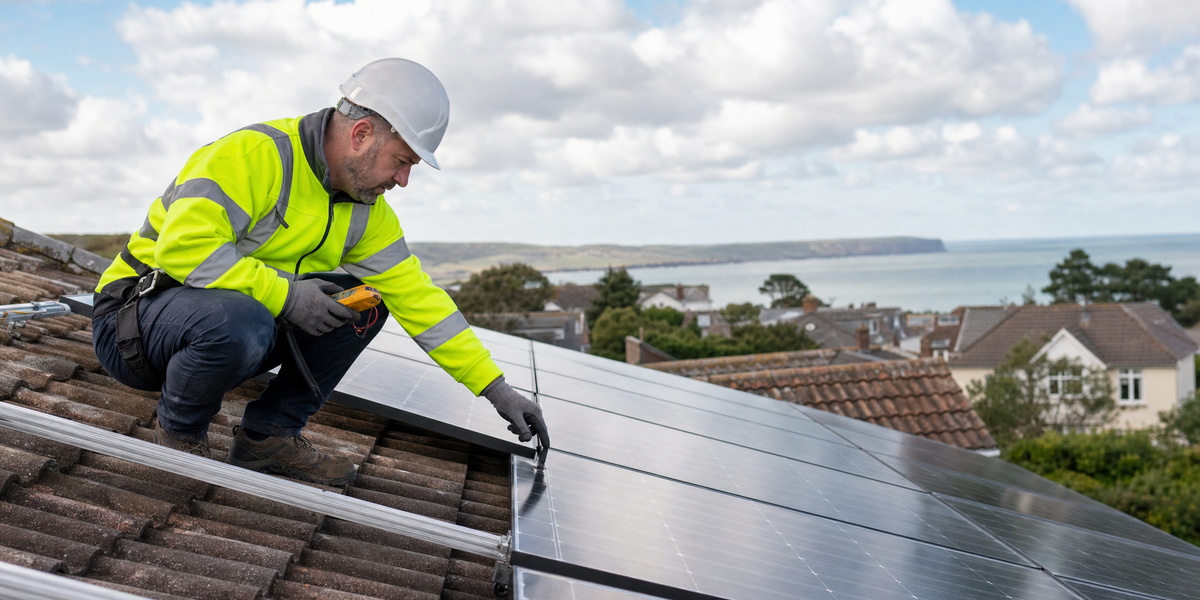
Solar Panel Inspection: What Gets Checked, What It Costs and How Often You Need One
Solar Panel Inspection: What Gets Checked, What It Costs and How Often You Need One
Last updated: 23 September 2026 | 12 min read | By No1 Solar Care
Most solar systems in the UK have been looked at exactly once. On the day they were commissioned, an engineer ran the tests, filled in the certificate, handed over the paperwork and left. For a system installed in 2012 under the Feed-in Tariff, that was fourteen years ago.
Nobody has been back since. Nobody has checked whether the DC connectors behind the panels are still tight, whether the inverter is still converting at the efficiency it started with, or whether the earthing the certificate relied on is still connected to anything. The panels look fine from the pavement. Panels always look fine from the pavement.
Across the 500+ systems we've installed and inspected between South Wales and the South Coast, the most common finding is not a system that has failed. It's a system that works, badly, and has done for years.
In summary: A solar panel inspection is a documented check of the panels, mounting, DC and AC wiring, inverter, protective devices and monitoring by a qualified engineer, measuring what the system produces against what it should. A full domestic inspection typically costs £100–£300 in the UK. Ours is a 21-point inspection we call the Solar MOT, £195 fixed, report the same day.
What is a solar panel inspection?
A solar panel inspection is a structured, documented assessment of a solar PV system's safety and performance, carried out by a qualified engineer. It covers the panels and their mounting, the DC cabling and connectors, the inverter, the AC side and protective devices, and the system's actual generation compared with what it should be producing.
That last part is what separates an inspection from a look. Anyone can stand in a garden and confirm the panels are still attached. An inspection measures. It records string voltages and currents, checks insulation resistance, confirms the earthing and bonding, reads the inverter's fault log and event history, and compares live output against a modelled expectation for the system's size, orientation and age.
The reference standards are worth knowing, because they tell you if you're getting the real thing. The MCS installation standard, MIS 3002:2025, now includes verification templates for both initial and periodic inspection, adapted from BS EN 62446-1. The IET Code of Practice for Grid-connected Solar Photovoltaic Systems sets out maintenance and monitoring requirements across the life of the installation. If an engineer can't tell you which of those they're working to, that tells you something.
What does a solar panel inspection actually check?
A proper inspection covers six areas: the roof and array, the DC route through the loft, the inverter, the consumer unit and AC protection, the battery if there is one, and the monitoring and documentation. On a standard domestic system that's 21 separate checks, each graded pass, advisory or fail.
Here's how ours breaks down. We publish the checklist because a homeowner should be able to hold any inspection, ours included, against it.
Seventeen of those checks happen on the roof and in the loft. That is deliberate. The inverter is the part people worry about because it has a screen, but the things that actually cause fires and leaks are the things nobody can see.
What is a solar panel electrical test?
The electrical test is the measured part of the inspection: insulation resistance on the DC strings, open-circuit voltage and short-circuit current for each string, polarity, earth continuity and the functional check of protective devices. It follows the test sequence in BS EN 62446-1, the same standard used at commissioning, so results can be compared directly with the original certificate.
That comparison is the whole point. A string that read 380 V open-circuit at commissioning and reads 320 V today has either lost a panel, gained a fault, or both. Without the original figures you're guessing. With them you can see exactly how far the system has drifted, and usually where.
Two things worth knowing. First, the DC side of a solar system cannot be switched off by turning the inverter off. As long as there is daylight on the panels, the string cables are live at several hundred volts. This is the main reason we ask people not to go into the loft with a screwdriver and a YouTube video. Second, a domestic Electrical Installation Condition Report (EICR) on the house wiring does not normally include the PV system in any detail. Electrical Safety First recommends an EICR every ten years for owner-occupied homes and every five in rented ones. A separate PV inspection is still needed.
How much does a solar panel inspection cost in the UK?
A full domestic solar panel inspection typically costs between £100 and £300 in the UK, depending on what's included. Basic visual-only checks sit at the bottom of that range; inspections with thermal imaging and a full electrical test sit at the top or above it. Ours is £195 including VAT, with no call-out fee and no travel charge.
The price spread reflects a real difference in what you get, so it helps to ask exactly what's included before comparing.
Market ranges above are drawn from published UK provider pricing and industry guides; individual quotes vary by region and system size. Commercial systems are quoted separately.
One detail that changes the maths: if we recommend work and you go ahead with it, the £195 comes off the bill. If we find nothing, you've paid £195 for the confirmation that your system is fine and a dated report proving it. Either way the inspection isn't the expensive part.
How often should solar panels be inspected?
Every year for systems over five years old, and at least every two years for newer ones. That is our view rather than a legal requirement, because there isn't one for owner-occupied homes. What there is: the Energy Saving Trust puts typical inverter replacement at around twelve years, and Electrical Safety First's ten-year EICR guidance was written for house wiring, not for equipment on a roof in the weather.
Think about what a solar system is exposed to. The panels sit outside through Channel storms, Bristol Channel salt, frost, forty-degree roof-surface summers and everything the gulls contribute. The mounting expands and contracts with every temperature cycle. Connectors behind the panels see the same. An annual look is not excessive. A visit every fourteen years, which is where most FiT-era systems now sit, is negligent.
The key takeaway: the systems most in need of an inspection are precisely the ones least likely to get one. Installed 2011–2015, original inverter, original installer long gone, no monitoring beyond a generation meter in the cupboard. If that's yours, this year is the year.
There are also four moments when an inspection stops being optional:
Before buying a house with panels, so you know what you're inheriting. When your installer has gone out of business, so you have an independent baseline for any warranty claim. After a storm with named-storm wind speeds. And whenever generation drops more than a few per cent year on year with no change in weather or shading, because panels degrade at well under 1% a year and anything faster is a fault.
What do solar panel inspections most commonly find?
Three things, in roughly this order: soiling and shading losses that nobody has noticed, inverters running below rated efficiency without a fault code, and mounting or wiring faults from years of thermal cycling. Most systems have at least one. Very few have none.
Soiling first, because it's the least dramatic and the most expensive. Dirt, moss at the lower panel edge, lichen on frames and bird droppings shade individual cells, and a shaded cell doesn't just stop producing, it heats up. On the South Coast the salt film makes it worse; in Cardiff and Newport it's traffic particulates along the M4 corridor that bond to the glass and don't rinse. We see output losses up to 25% on arrays that have never been cleaned.
Inverters second. They lose 10–15% efficiency gradually, long before any warning appears, and roughly one in three fails outright before year fifteen. When one fails the system produces nothing. Not less. Nothing. Without monitoring, the first sign is usually a bill.
Then the things you'd never see. A UK study published in npj Materials Degradation analysed aerial thermography of 3.3 million PV modules on commercial-scale UK sites and found thermal defects in 36.5% of them, with defective modules running on average 21.7°C hotter than healthy ones. Sites with more defects degraded at 2.6% a year against 1.2% for cleaner sites. Those are commercial arrays, not houses, but the physics on a roof in Poole is the same physics. Heat is damage, and damage compounds.
Can I inspect my solar panels myself?
You can do a useful check from the ground and from your monitoring app. You cannot do the inspection. The DC side stays live in daylight, roof work without edge protection is how people end up in Poole Hospital, and the measurements that matter need test equipment and the original commissioning figures to compare against.
Here's what's safe and worth doing every month:
Check your generation figure against last year. Same month, same panels. A drop of more than 2–3% with similar weather is worth a call. If you have no record, start one now.
Look at the inverter display or app. Green light, no error code, a generation figure that changes through the day. A red light or a code you don't recognise means it's time to ring someone.
Look at the panels from the ground with binoculars. Obvious debris, a panel sitting at a different angle from its neighbours, moss along the bottom edges, nesting material poking out from under the array.
Listen to the inverter. A new buzz, a fan running constantly, or clicking are all signs it's working harder than it should.
Find your paperwork. MCS certificate, DNO notification, panel and inverter warranties. If you can't find them, ask for a documents check as part of the inspection.
Please don't go on the roof. Please don't open the inverter. Please don't put a multimeter on anything with a DC label. We have attended enough of the aftermath.
What happens after a solar panel inspection?
You get a written report the same day, with photographs, a traffic-light grade for each of the six areas and a prioritised list of anything that needs attention, priced. Anything that can safely wait, the report says so. Then you decide, with no obligation to use us for the work or to do anything at all.
That report is yours. Take it to another company. Put it in the drawer with the house documents. Use it as the baseline for next year. Most people, having seen what's actually going on up there, choose one of two routes.
The first is a one-off repair. A failed DC connector, a loose rail, a bird-proofing job. We price it, the £195 comes off, done.
The second is a care plan, which is where the inspection stops being an event and becomes a habit. Care Plus at £29.99 a month is the one most people with a system over five years old end up on: everything in the remote-monitoring Care plan, plus an engineer on site every year for the full inspection and electrical test, a customer portal with every report, and 30% off call-outs. Start a plan at the same time and the inspection itself is £95 rather than £195.
We install systems as well as maintain them, and on the ones we've fitted the engineer who comes back to inspect is the engineer who put it up. That doesn't help you if someone else installed yours. It does mean we've seen what a good install looks like from underneath, and what a poor one looks like ten years on.
Book a solar panel inspection
Five quick questions, then we call you back within one working hour. £195 fixed, including VAT, credited against any work you go ahead with.
South Coast (Dorset & Hampshire): call 01202 023069 South Wales (Cardiff, Newport, Swansea): call 029 2002 6002
Check your system in 60 seconds →
MCS-certified engineers · Checkatrade 10/10 · 500+ systems installed and inspected
Frequently asked questions
What is included in a solar panel inspection?
A full inspection covers the roof and array, the DC cabling and connectors in the loft, the inverter, the consumer unit and AC protection, any battery, and the monitoring and paperwork. It includes an electrical test to BS EN 62446-1 and a comparison of actual generation against expected. Ours has 21 checks, each graded pass, advisory or fail, with a same-day written report.
How much does a solar panel inspection cost?
Between £100 and £300 for a domestic system in the UK, depending on whether it includes a full electrical test. Visual-only checks are cheaper; specialist thermal imaging surveys cost more. Our 21-point Solar MOT is £195 including VAT, or £95 alongside a care plan, with no call-out or travel fee and the £195 credited against recommended work.
How long does a solar panel inspection take?
Around one to two hours for a standard domestic system, longer with a battery or a large or awkward roof. You don't need to be in for the roof and loft work, but we do need access to the inverter and consumer unit and we'd rather go through the report with you in person.
Is a solar panel inspection a legal requirement?
Not for owner-occupied homes. Landlords need a five-yearly EICR on the property's electrics, but that doesn't cover the PV system in detail. Your panel and inverter warranties may, however, require evidence of maintenance, and an insurer can ask the same after a fire or leak claim. A dated inspection report is how you prove it.
Does a solar panel inspection include cleaning?
Not as standard. The inspection tells you whether cleaning is needed and how much output you're losing to soiling, which is usually more useful than a reflex clean. If it is needed we quote it separately, and on the Care Pro plan an annual professional clean is included.
My installer has gone out of business. Can you still inspect the system?
Yes, and you should. An independent inspection gives you a baseline that no longer depends on a company that isn't there, and it's the first thing a panel or inverter manufacturer asks for when you claim under their warranty directly. Bring whatever paperwork you have; we'll tell you what's missing.
Will you try to sell me a new inverter?
Only if yours has failed or is about to. The report grades everything and says what can wait. Most of what we find is fixable for less than the cost of the inspection, and the £195 comes off any work anyway, so there's no incentive for us to invent a problem.
Do you inspect systems you didn't install?
Yes. Most of the 500+ systems we've inspected were fitted by someone else. Any make of panel or inverter, any age, across Dorset, Hampshire and South Wales.
The odd thing about solar is that it's the only expensive piece of equipment on a house that gets no attention at all after day one. Boilers get serviced. Cars get MOTs. Roofs get looked at when they leak. Panels sit there for fifteen years producing a number nobody checks against anything.
An inspection is how you find out what the number should have been.