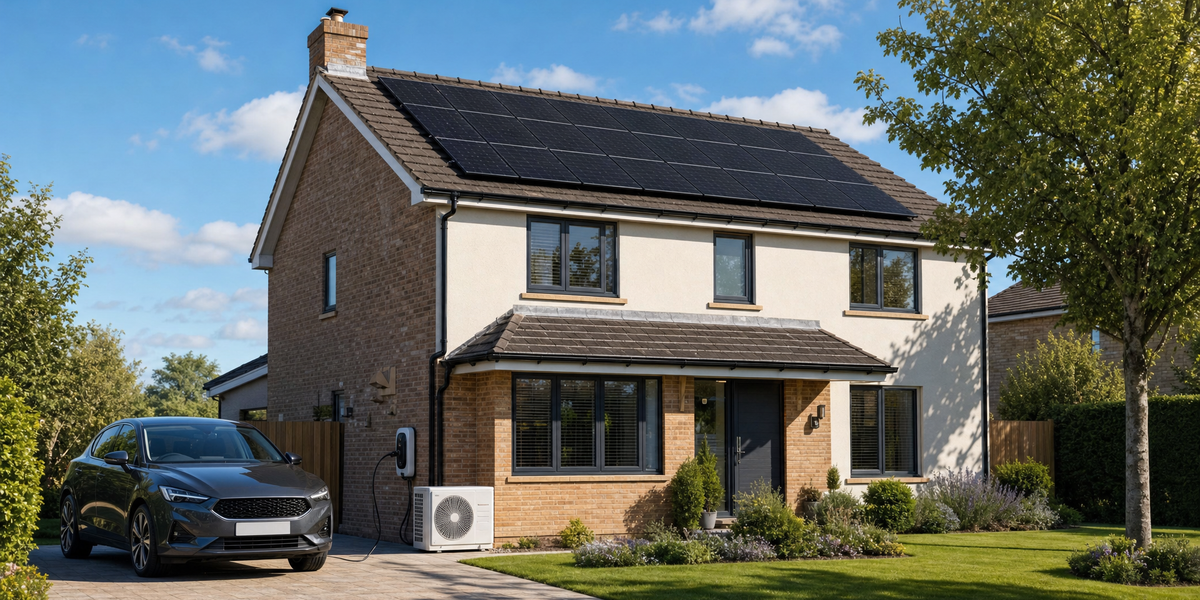
Net Zero Targets and Solar Panels: What UK Homeowners Should Do Now
The UK's legally binding commitment to reach net zero carbon emissions by 2050 is no longer an abstract government ambition. It is shaping planning policy, building regulations, energy tariffs and, increasingly, what buyers expect when they purchase a home. For anyone already living with solar panels, or thinking seriously about installing them, understanding how UK net zero solar panels homes fit into this picture is genuinely useful. The decisions you make in the next few years about your system's condition, storage capacity and output could determine how well your home performs against tightening efficiency standards and how much you actually save on energy costs as prices continue to shift.
What Net Zero Actually Means for UK Homes
The UK government enshrined net zero into law through the Climate Change Act 2008, with the 2050 target confirmed in 2019. To get there, residential housing needs to account for a significant portion of the national effort. Homes currently contribute around 20 per cent of the country's total greenhouse gas emissions, largely through gas heating and electricity consumption from fossil fuel sources. The plan is not simply to build cleaner new homes. Millions of existing properties need to be upgraded, and solar generation sits at the heart of that.
The Energy Saving Trust estimates that a well-maintained 4kWp solar panel system can save a typical household over 900kg of CO2 per year compared to grid electricity. Multiply that across the millions of homes the government wants to improve by the mid-2030s and the contribution becomes significant. The Solar Energy UK trade body has consistently argued that residential solar is one of the most cost-effective routes to decarbonising the housing stock. The challenge is that a large proportion of installed systems are now ageing, underperforming or simply not being looked after well enough to deliver on their potential.
The State of Existing Solar Panels Across the South Coast
The South Coast, including Bournemouth, Poole, Dorset and Hampshire, has one of the highest concentrations of solar panel installations in the country. The region benefits from above-average sunshine hours, and many homeowners took advantage of the Feed-in Tariff scheme introduced in 2010. According to Ofgem's FiT data, hundreds of thousands of UK households signed up during that period, and a large number of those installations are now 10 to 15 years old.
Systems of that age are not necessarily past their best, but they do need attention. Solar panels degrade gradually over time, typically losing around 0.5 per cent of their peak output per year under normal conditions, though environmental stressors can accelerate this. Coastal properties along the South Coast face an additional challenge that inland homeowners rarely think about. Salt air, carried inland from the sea, leaves a residue on panel surfaces and can corrode mounting hardware, junction boxes and electrical connections over time. Our article on how salt air damages solar panels on the South Coast covers this in detail, but the short version is that a system that looks fine from the ground may be losing meaningful output.
For net zero purposes, a system generating 15 or 20 per cent less than its rated capacity is not just a financial underperformance. It is a carbon reduction that is not happening. That gap matters.
UK Net Zero Solar Panels Homes: Why Maintenance Is the Missing Link
There is a tendency among homeowners to treat solar panels as fit-and-forget technology. Once they are on the roof, the assumption is that they get on with it. That assumption is understandable, because for the first few years it is mostly true. But as systems age, the maintenance question becomes more pressing, and in the context of UK net zero solar panels homes, it also becomes a policy question.
The Energy Performance Certificate register already reflects solar generation in a home's EPC rating. As the government moves toward tightening minimum EPC standards, possibly requiring rental properties to reach EPC Band C by 2030 and pushing owner-occupied homes in the same direction, a poorly maintained solar system could drag a rating down rather than lift it up. A system that is technically installed but not performing properly may not deliver the credit assessors expect.
This is where professional servicing makes a real difference. No1 Solar Care's Solar MOT service is designed specifically to identify the kinds of hidden problems that erode output quietly over time: loose connections, failing diodes, partial shading from accumulated debris, and inverter issues that do not always trigger visible error codes. Getting that kind of structured inspection done now, before efficiency standards tighten further, is a sensible move.
For further context on what neglected systems actually cost homeowners over time, the analysis in the true cost of neglecting your solar panels is worth reading. The numbers involved are not trivial.
Battery Storage and the Net Zero Equation
One of the most significant developments in residential solar over the past few years is the growing affordability of battery storage. For homes aiming to contribute meaningfully to net zero targets, a solar array alone only gets you so far. Without storage, excess generation during the day is exported to the grid (often at low Smart Export Guarantee rates), while evening demand pulls from grid electricity that may still carry a carbon cost.
Adding a battery changes that dynamic. Energy generated during peak sunshine hours can be stored and used after dark, reducing grid dependence and improving the real-world carbon performance of the home. If you are on the South Coast and wondering whether battery storage is worth the investment at this point, this detailed breakdown for South Coast homeowners covers the numbers honestly.
The Smart Export Guarantee, administered by Ofgem, means you will receive payment for surplus electricity you send back to the grid even without storage. But the rates vary considerably between suppliers, and maximising your return generally means being strategic about when you export and when you store. For households on older FiT contracts, the picture is different again and those legacy systems deserve particular attention as they age.
Grants, Incentives and What South Coast Homeowners Can Claim
The financial case for upgrading or improving your solar setup has improved over the past couple of years. VAT on solar panels and associated equipment was reduced to zero per cent in April 2022, as confirmed by HMRC guidance on VAT for energy-saving materials. That alone represents a meaningful saving on new installations or significant upgrades.
Beyond that, the Warm Homes Plan being developed by the current government is expected to direct funding toward home energy improvements including solar. Dorset and Hampshire households may benefit depending on how the scheme is structured. For an early picture of what to expect, this overview of the Warm Homes Plan for Dorset and Hampshire homeowners is a useful starting point.
The ECO4 scheme, funded through energy suppliers and overseen by Ofgem under the Energy Company Obligation, also remains relevant for lower-income households looking to improve home energy performance. Eligibility is means-tested, but for qualifying households the support available can be substantial.
For a broader picture of what is currently available to claim in 2026, this guide to UK solar panel grants and incentives for South Coast homeowners covers the main options in one place.
What Homeowners With Older Systems Should Do Right Now
If your panels were installed between 2010 and 2016, which covers the peak FiT installation years, your system is between 10 and 16 years old. The panels themselves may have many years of useful life left, but several components deserve scrutiny.
Inverters, for instance, typically have a shorter lifespan than the panels they serve. A string inverter from that era may be approaching or past its expected service life of 10 to 15 years. If it is showing signs of strain or has not been checked recently, it is worth investigating before it fails completely. The cost-benefit analysis on replacing an old solar inverter helps clarify when it makes financial sense to act rather than wait.
Mounting systems also need checking. Metal fixings, roof penetrations and panel clamps can all degrade, particularly on coastal properties in Bournemouth and along the Dorset coastline where salt and moisture accelerate corrosion. A professional inspection through No1 Solar Care's Solar MOT will assess all of these components systematically, giving you a clear picture of your system's current health and what, if anything, needs addressing.
If you want to start with a quick sense of where things stand before booking a full inspection, the 60-second solar health check on the No1 Solar Care website is a practical first step.
New Builds, the Future Homes Standard and What It Signals
For homeowners thinking beyond their current property, or those considering extensions and renovations, the Future Homes Standard is worth understanding. The standard is expected to require new homes built from 2025 onward to produce 75 to 80 per cent fewer carbon emissions than homes built under previous regulations. In practice, that means solar panels and heat pumps will become standard features of new builds rather than optional extras.
What this signals for existing homeowners is a direction of travel. Homes without solar generation, or with underperforming systems, will increasingly stand out in the market. For Dorset homeowners in particular, this detailed look at the Future Homes Standard and what it means for solar panel owners in Dorset is worth reading before any significant home improvement decision.
The Met Office consistently records Bournemouth and the wider South Coast as one of the sunniest parts of the UK, with annual sunshine hours regularly exceeding the national average. That is an asset. Homes in this part of the country are well placed to generate meaningful solar output, provided their systems are working properly. Wasting that natural advantage because of avoidable maintenance issues makes no sense from either a financial or a net zero perspective.
Getting your system properly assessed through a Solar MOT is one of the most direct actions any South Coast homeowner can take right now to make sure their contribution to the UK's net zero goals is actually being delivered, not just promised.
Frequently Asked Questions
How do UK net zero solar panels homes contribute to the 2050 target?
Residential solar generation directly reduces demand for grid electricity produced from fossil fuels. Homes account for roughly 20 per cent of UK emissions, so well-maintained solar systems across millions of properties represent a substantial portion of the national decarbonisation effort. Keeping your system performing at its rated capacity matters both individually and collectively.
Will my EPC rating be affected if my solar panels are underperforming?
Yes, it can be. EPC assessors take solar generation into account when rating a property's energy performance. A system that is installed but delivering significantly less than its rated output may not earn the rating uplift you would expect. Getting the system properly maintained and documented before an assessment is worthwhile.
Are there specific risks for solar panels on the South Coast compared to inland properties?
Coastal properties in areas like Bournemouth, Poole and along the Hampshire coastline face salt air exposure that can degrade panel surfaces, corrode mounting hardware and affect electrical connections faster than you might expect. Regular inspection and cleaning is especially important for homes within a few miles of the sea.
Is battery storage worth adding to an existing solar system in 2026?
For many South Coast homeowners, yes. Battery storage allows you to use more of what you generate rather than exporting it at low Smart Export Guarantee rates. The economics depend on your current usage patterns, your generation profile and the cost of your chosen battery system. A professional assessment can help you model the return before committing.
What government support is available for solar improvements right now?
Zero per cent VAT on solar equipment remains in place for 2026. The Warm Homes Plan is expected to bring further funding, and ECO4 continues to support eligible lower-income households. South Coast homeowners should check current eligibility carefully, as the support landscape is changing and some schemes are time-limited.
How often should I have my solar panels professionally inspected?
For most systems, a thorough inspection every one to two years is a sensible baseline. Older systems, coastal installations in Dorset and Hampshire, or any system that has not been checked in several years should be prioritised. An annual Solar MOT service from No1 Solar Care covers all the key components and gives you a written record of the system's condition.
What happens if my solar installer has gone out of business and I need repairs?
This is more common than most homeowners realise, particularly with systems installed during the FiT boom years. Your warranties may still be valid through the manufacturer even if the installer has closed. An independent specialist like No1 Solar Care can assess the system, carry out repairs and advise on your options regardless of who originally installed the panels.
Book your Solar MOT today. Call 01202 023069 or visit no1solarcare.co.uk/solar-mot