Rota Power Cuts and Solar Panels: What the New Emergency Rules Mean for Your Home
Last updated: 27 October 2026 | 11 min read | By No1 Solar Care
Ofgem published its decision on 30 July 2026. Two weeks later, on 13 August, a new section of the Grid Code came into force that lets the National Energy System Operator, NESO, order rotating power cuts (often called rolling blackouts) across Great Britain. (Some coverage says 14 August. Ofgem's own decision page gives the 13th.)
It is a last resort. Ofgem calls demand control "an essential last resort component of system operation", and nothing in the rules schedules a cut. But the machinery now exists, it has a name, and it has been in the news, so solar owners keep asking us the same thing. Will the panels keep the lights on?
Short answer: no. Panels on their own go off with the grid. A battery can change that, but only a particular kind, set up in a particular way.
In summary: Since mid-August 2026 the Grid Code lets NESO order rotating local power cuts, nominally three hours per block, when it has at least eight hours' warning of a supply shortfall. It is a last-resort tool. Solar panels alone shut down during any power cut for safety, so only a battery installed for backup can keep a home running.
What are the new rota power cut rules?
Since mid-August 2026 the Grid Code and Distribution Code have included the Demand Control Rotation Protocol. It lets NESO order rotating local power cuts, on a nominal three-hour cycle, where there is at least eight hours' warning of an electricity shortfall. It is a last-resort tool, not a timetable.
The protocol comes from two code changes that Ofgem approved together: GC0176 for the Grid Code and DCRP/MP/25/06 for the Distribution Code. NESO raised GC0176 in November 2024, and the Energy Networks Association proposed the distribution change in December 2025. Ofgem's decision page says the protocol is modelled on the government's Electricity Supply Emergency Code, known as ESEC.
The difference that matters is speed. Press reports say ESEC can only be triggered by ministers, whereas NESO can start this protocol itself. Here is what the decision sets out.
The eight-hour condition tells you what this protocol is for. It covers a shortage you can see coming. Sudden problems are still handled by the older emergency disconnection tools, which is what the four fast blocks are kept for. As we read it, those older tools leave far less time to prepare.
How likely is a rota power cut?
Nobody outside NESO can put a number on it, and we won't invent one. According to press reports, NESO calls the power a last-resort measure for use only in "the most extreme and unlikely circumstances". The rules do not mean a cut has been scheduled. They mean a plan exists if one is needed.
A few details are worth knowing. The government has said it is very confident in its security of supply arrangements, as reported by the Telegraph. Ofgem's reasoning was about fairness: rotating the cuts spreads them across the country rather than leaving the same areas off for the whole shortage.
Separately, Ofgem changed its guidance to network operators with effect from 17 April 2026, giving them relief from certain licence obligations and guaranteed standards during rota disconnections. That is a sign of how seriously the plan has been prepared, though not of how likely it is to be used.
How would I know a rota power cut was coming?
NESO has to give the networks a notice at least eight hours ahead. How your own network then reaches households is less clear, because the decision documents we read do not set it out. Check your network operator's website, and call 105, the free power cut line.
The older ESEC plan gives a hint at what to expect. Its guidance says rota plans would be published on Powercut105.com, with up to a week's notice on a rolling basis. We don't yet know whether the new protocol will follow the same pattern.
Your network operator, rather than your electricity supplier, is the body that switches areas off. In most of Dorset and Hampshire that is SSEN. In South Wales it is National Grid Electricity Distribution. You can confirm yours on the Energy Networks Association's "Find my network operator" tool.
Do solar panels work in a power cut?
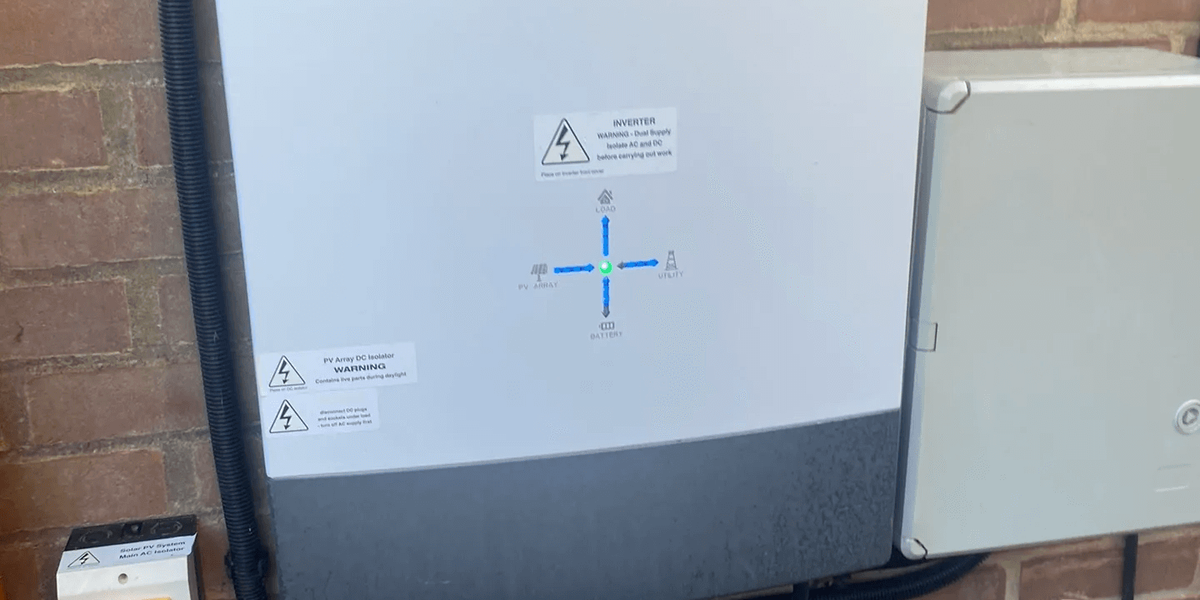
No, not on their own. A standard grid-connected system shuts down automatically when the grid goes off, even on a bright day. It is a safety feature, there so that engineers working on the network are not met by power coming back down the line from your roof. Most inverters restart by themselves once the grid returns.
UK Power Networks puts it plainly: solar systems are "designed to shut down automatically during a power cut", and usually restart automatically after a short delay, often around 20 seconds. Some may display status messages or need checks in line with the manufacturer's guidance.
Timing matters too. The ESEC rota plans are expected to bite mostly at the morning and evening demand peaks. Those are exactly the hours when a panel produces least, particularly between October and February. Even a system that could run the house at noon in June would have little to offer at 6pm in January. Our guide to solar panels in winter explains why.
Can a home battery keep my lights on during a rota cut?
Only if it is designed for backup. UK Power Networks says battery storage will usually shut down in a power cut unless it is built to run in backup, or "island", mode. That means the home is isolated from the grid and a chosen set of circuits runs from stored energy. Not every battery can do this.
The things that decide how well backup works are mundane. They include the battery model, the isolation equipment, which circuits it covers, how much power it can deliver at once, and how full it is when the cut begins. If you set an energy reserve for outages, a higher reserve gives more protection and leaves less for everyday savings.
Do the arithmetic before you assume anything. Energy in kilowatt-hours is power in kilowatts multiplied by hours. These loads are illustrative, not readings from a real home.
Our Poole page prices a 5kWh or 10kWh battery at £3,000 to £5,000, and a 5kWh unit that starts the evening at 20% full holds around 1 kWh. That would not cover the middle row. The batteries in our recent work gallery include Sunsynk, Tesla Powerwall, GivEnergy, SolaX and Soluna units, and whether a given one can power a home in a cut depends on its model and how it was wired.
The key takeaway: a battery bought to cut bills is not automatically a backup system. Backup is a specific design choice, and it needs asking for.
What should solar owners do before a rota power cut?
You can't prevent a cut, but you can avoid being surprised. Most of it is knowing what your own system does. None of these steps need a ladder.
Step 1: find out whether your battery can run in a cut. Look for a backup gateway or a backup setting in the app, check the manual, or ask your installer. Do it now rather than at hour seven of eight.
Step 2: if it can, check which circuits it powers. Many systems cover selected circuits only. Work out how many hours that buys using the table above.
Step 3: know your inverter. Find it, find its display, and learn what the normal status looks like. After a cut, a restart can take a short while, and some systems show a status message first.
Step 4: give it time before you fiddle. If it has not restarted after the grid has been back for a while, follow the manufacturer's guidance. If it still won't come back, book a check.
Step 5: don't treat a domestic battery as life support. If anyone in your home relies on medical equipment, speak to your network operator about the Priority Services Register and have a plan that does not depend on a home battery.
Does a power cut damage solar panels or inverters?
Not as a rule. Shutting down and restarting is what a grid-connected inverter is built to do. What deserves attention is a system that fails to restart, or shows a fault after the power returns. We don't have data showing that outages cause failures, and we won't pretend otherwise.
The sensible reading is that an inverter near the end of its life is the one most likely to show it. The Energy Saving Trust says inverters usually need changing after about 10 to 12 years, at around £800. If yours is in that range, an inspection before the winter costs far less than finding out during a cut. Our inverter troubleshooting guide covers the common fault codes.
Is it worth buying a battery because of the new rules?
Not on this alone. The rules are a last resort with no schedule, and most home batteries are bought to cut bills. If outage protection matters to you, ask for backup by name, because it changes the equipment as well as the settings. If it doesn't matter, don't pay for it.
If you do want it, ask for the backup hardware to be quoted as a separate line. The Poole figure of £3,000 to £5,000 covers the battery, and we would not assume it includes everything needed for backup. Our site says 0% VAT on solar and battery installations ends on 31 March 2027, which is covered in our guide to what the VAT change is worth. For the bill-saving case, see Is solar battery storage worth it?.
Check your system before the winter
Already have solar? Our Solar MOT is a 21-point inspection, £195 fixed, with a written report and traffic-light grading the same day. Book through our five-question system check. Thinking about a battery with backup? Start with a free quote.
South Coast: 01202 023069. South Wales: 029 2002 6002. Rated 9.9/10 on Checkatrade across 116 reviews, MCS-certified engineers, 500+ systems inspected.
Frequently asked questions
Are rota power cuts the same as rolling blackouts?
Broadly, yes. "Rota power cuts" is the term Ofgem, NESO and the government's emergency code use. "Rolling blackouts" is the everyday phrase for the same idea: different areas are switched off in turn, for a limited time each, so that a shortage is shared out rather than hitting the same homes throughout. In Great Britain the new protocol works on a nominal three-hour cycle.
When did the rota power cut rules start?
Ofgem's decision was published on 30 July 2026, and it gives 13 August 2026 as the implementation date. Some press and installer coverage says 14 August. The change adds the Demand Control Rotation Protocol to the Grid Code and the Distribution Code.
How long would a rota power cut last?
The protocol describes a nominal three-hour cycle, and press coverage describes areas being cut off for up to three hours at a time. The decision documents we read do not state a hard maximum, so treat three hours as the planning figure rather than a guarantee.
How much warning would I get?
The protocol can only be used where there is at least eight hours' advance warning of a shortfall, and NESO must notify the networks at least eight hours ahead. The decision does not set out how households are told. Sudden failures are still dealt with by the older emergency tools, with less notice.
Are homes with medical needs exempt?
Not automatically. The protected list covers critical sites such as hospitals, and up to 10% of demand is reserved for them. Ordinary homes are not on it. If someone at home relies on medical equipment, talk to your network operator about the Priority Services Register.
Will my solar panels keep working?
No. A grid-connected system shuts down automatically in a power cut, whatever the weather. It usually restarts by itself after a short delay once the grid returns. Only a battery set up for backup can power selected circuits while the grid is off.
Do I need a battery with backup?
Only if keeping power on in an outage is worth paying for. Most home batteries are bought to cut bills and do not provide backup. If you want it, ask your installer for backup specifically and have the circuits it covers set out in writing.
Is this the same as the government's emergency code?
No, but it is modelled on it. ESEC is the longer-term national plan and, according to press reports, can only be triggered by ministers. The new protocol uses similar load blocks but can be started by NESO and put in place within eight hours.
The short version
Rota cuts are a contingency plan, not a forecast. If one ever happens, a solar system without a backup battery will go off with the grid like everything else, then come back on its own. If a cut would matter to you, find out now what your battery can do, because that is the part you can still change.