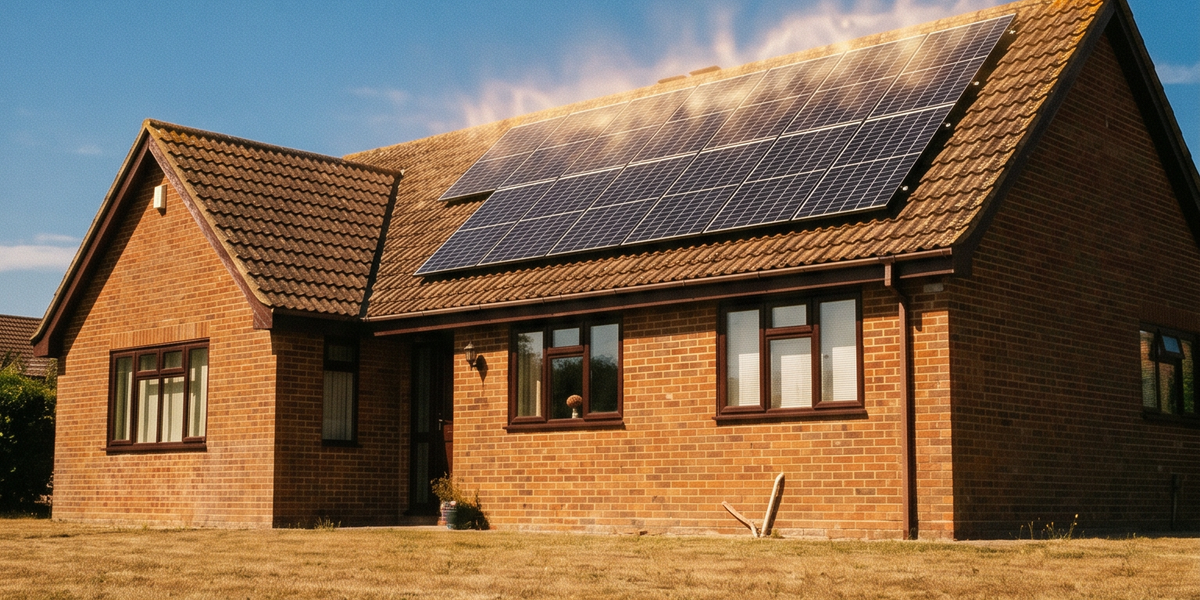
Do Solar Panels Work Better in a Heatwave? The Truth for UK Homeowners
Every summer, when temperatures creep above 30°C across the South Coast, solar panel owners tend to feel quietly smug. Surely all that blazing sunshine means their system is working flat out? In reality, heatwave solar panel output in the UK often disappoints homeowners who haven't heard about something called the temperature coefficient. Hot weather and high solar output are not the same thing, and understanding the difference could save you from losing a significant chunk of your system's potential generation over the coming years.
This is not a niche technical concern. It affects every solar panel on every roof in Bournemouth, Dorset, Hampshire and beyond. Getting to grips with the real relationship between heat and solar performance is genuinely useful, whether you had your panels installed last spring or a decade ago.
How Solar Panels Actually Generate Electricity
To understand why heat causes problems, it helps to know the basics of how photovoltaic panels work. Solar cells generate electricity by absorbing photons from sunlight and using that energy to knock electrons loose, creating a flow of current. The process depends on light, not heat. Sunlight and heat tend to arrive together on a clear summer day, but they are entirely separate things, and the cells respond to them in very different ways.
Solar panels are tested and rated at a standard temperature of 25°C. That figure is called Standard Test Condition, or STC. It's the benchmark used to calculate the wattage printed on every panel's spec sheet. On a warm but not scorching day with strong sunshine, a panel rated at 400W might genuinely deliver close to that figure. Push the cell temperature well above 25°C, though, and output starts to fall.
What Is the Temperature Coefficient?
The temperature coefficient is the rate at which a solar panel loses efficiency for every degree the cell temperature rises above 25°C. Most standard silicon panels have a temperature coefficient of around minus 0.3% to minus 0.5% per degree Celsius. That sounds modest, but the numbers add up quickly during a proper heatwave.
On a hot summer day in Dorset, rooftop panel temperatures can easily reach 60°C or even 70°C. If we take a conservative cell temperature of 60°C on a sunny day, that's 35°C above the STC reference point. At a coefficient of minus 0.4%, you're looking at a 14% reduction in output from that panel alone. On a 4kW system, that's potentially 560W of generation simply lost to heat. Across the course of a long, hot summer day, that loss compounds into a meaningful chunk of electricity and money.
Why UK Summers Are Actually Good for Solar (Despite the Heat)
Here's where things get more nuanced. The UK's climate, including the South Coast, tends to produce solar conditions that are often better than homeowners expect, even if they're not always what people imagine.
The ideal solar day in Britain is not a heatwave. It's a bright, clear day in late spring or early autumn, when temperatures sit between 15°C and 20°C and the sun is high enough in the sky to deliver strong irradiance. Under those conditions, panels run close to their rated output without the thermal penalty of extreme heat.
That said, a heatwave in Hampshire or along the Dorset coast still produces significantly more solar generation than a cloudy 18°C day in March. The irradiance, which is the intensity of the solar radiation hitting the panels, is so much higher during peak summer that it more than compensates for the thermal losses in most cases. So you will almost certainly generate more electricity during a July heatwave than you would in February. The point is that you'd generate even more on that same July day if temperatures were 10°C cooler.
Clouds Can Actually Help on a Hot Day
There's a phenomenon that surprises many solar owners. On days when there is intermittent cloud cover alongside strong sunshine, panels sometimes produce brief spikes above their rated output. This is called the edge-of-cloud effect. When sunlight reflects off the edges of clouds, it can intensify the irradiance hitting the panels momentarily. Combined with the slight cooling effect of cloud shadow, these brief spikes can push output unusually high for short periods. It's not something you can plan around, but it's a real effect that many monitoring systems pick up.
Heatwave Solar Panel Output UK: What the Numbers Look Like in Practice
Let's put some real context around this. The UK saw extended heatwaves in both 2022 and 2023, with parts of the South Coast recording temperatures above 40°C in July 2022. During that period, solar generation figures across the UK were actually lower than models had predicted based purely on irradiance data, precisely because panel temperatures were so extreme.
A typical domestic system in Bournemouth might generate somewhere between 3,500 and 4,500 kWh per year depending on system size, orientation and shading. During a two-week heatwave, a 4kW system might produce 10% to 15% less per day than it would on a cooler bright day with the same amount of sunshine. Over a sustained hot spell, that can add up to 20 to 40 kWh of lost generation, which at current electricity rates is a tangible amount of money.
The practical takeaway is this: heatwaves are not disasters for solar owners, but they are not the windfall people assume either. Your system will still perform well. It just won't perform as well as you might hope.
The Role of Panel Condition and Cleanliness During Hot Weather
Heat stress is harder on panels that are already compromised. A system with micro-cracks in the cells, degraded encapsulant, or failing connections will shed performance more rapidly under thermal stress than a well-maintained system will. This is one of the reasons why a professional inspection matters, particularly heading into summer.
Dirt and soiling are another issue that becomes more significant during hot, dry spells. In Dorset and Hampshire, summer often brings dry, dusty conditions with little rainfall to naturally clean the panels. Bird droppings accumulate. Pollen, dust and general grime build up across the glass surface. Even a relatively light layer of soiling can reduce output by 5% to 10%, and heavily soiled panels can lose considerably more. When you combine soiling losses with thermal losses during a heatwave, the impact on your generation can be meaningful. For coastal homes, salt deposits add another layer to the problem.
No1 Solar Care's professional cleaning service removes all of that soiling safely and effectively, without the risk of scratching the glass or voiding manufacturer warranties through improper cleaning methods.
Why a Solar MOT Before Summer Makes Sense
No1 Solar Care's Solar MOT is a thorough health check designed to catch problems before they cost you generation or worse. The inspection covers panel condition, string performance, inverter operation, mounting and fixings, and overall system output. Technicians use thermal imaging and electrical testing to identify faults that are completely invisible to the naked eye, including hotspots caused by cell damage that are significantly worsened by high temperatures.
Booking a Solar MOT before the summer heat arrives means you go into the peak generation season knowing your system is in the best possible shape. For homeowners on the South Coast who depend on summer generation to offset electricity bills and feed-in tariffs, that peace of mind is worth considerably more than the cost of the inspection.
What Happens to Your Inverter in a Heatwave?
Panel efficiency isn't the only thing affected by extreme heat. Inverters, which convert the DC electricity generated by your panels into usable AC electricity for your home, are also sensitive to temperature. Most inverters are designed to operate within a specific temperature range, typically up to around 45°C to 55°C ambient temperature. When they overheat, many will automatically reduce their output or shut down temporarily to protect their internal components.
If your inverter is installed in a south-facing garage or a poorly ventilated utility room, it may struggle during a prolonged heatwave. Symptoms include reduced output during the hottest part of the day and occasional error codes or shutdowns. Ensuring good ventilation around your inverter and keeping it out of direct sunlight are practical steps that make a real difference.
During a Solar MOT, No1 Solar Care checks inverter performance and installation conditions as part of the full assessment. It's a commonly overlooked factor that can genuinely limit your system's summer performance.
Practical Steps South Coast Homeowners Can Take
There are several sensible actions you can take to make sure your system performs as well as possible during the hot months. Getting your panels professionally cleaned before summer removes the soiling layer that amplifies heat losses. Checking your monitoring data regularly lets you spot any unexplained drops in output that could signal a developing fault. Our free 60-second solar health check is a quick way to assess whether your system needs a closer look. Making sure your inverter location is well ventilated reduces the risk of thermal throttling. And having a professional inspection carried out before peak season means any underlying issues are found and fixed while there's still time to benefit from the best generating months.
For homeowners in Bournemouth and across the South Coast, No1 Solar Care covers all of this. The team understands the specific conditions of the local climate, including the dust and pollen levels, the angle of the summer sun at this latitude, and the types of systems most commonly installed in the region.
Frequently Asked Questions About Solar Panel Performance in Hot Weather
Does hot weather increase heatwave solar panel output in the UK?
Not in the way most people think. Hot weather brings more sunshine, which does increase generation. But high cell temperatures reduce efficiency. On a very hot day, panels can lose 10% to 15% of their potential output due to heat alone. The net result is still good generation, just not as high as you'd get on a cooler, equally sunny day.
At what temperature do solar panels start losing efficiency?
Panel efficiency begins to drop above 25°C cell temperature, which is the standard test condition. On a summer day in Dorset, roof-mounted panels can easily reach 60°C to 70°C. At that temperature, a typical panel loses between 14% and 18% of its rated output due to the temperature coefficient, which is around minus 0.3% to minus 0.5% per degree above 25°C.
Can solar panels be damaged by extreme heat?
Prolonged extreme heat can accelerate existing damage and contribute to long-term degradation. Micro-cracks, delamination and hotspots are all worsened by high temperatures. A panel that is already compromised will suffer more during a heatwave than a healthy one. This is exactly why professional inspection before summer is worth considering.
How does dirty glass affect solar output during a heatwave?
Dirty panels lose 5% to 10% of output under normal conditions. During dry summer spells along the South Coast, pollen, dust and bird droppings build up faster with no rain to wash them away. Combined with heat losses, a dirty panel in a heatwave could be performing 20% or more below its potential. Professional cleaning before summer is one of the most cost-effective things you can do.
What should I check on my solar system before a heatwave?
Check your monitoring data for any unexplained output drops. Make sure your inverter has adequate ventilation and isn't exposed to direct sunlight. Consider having the panels professionally cleaned. If you haven't had a professional inspection recently, our Solar MOT covers all the key checks including thermal imaging, electrical testing and inverter assessment.
Why does my solar output sometimes spike on cloudy days?
This is the edge-of-cloud effect. When sunlight reflects off the edges of clouds, the irradiance hitting your panels can briefly exceed normal levels. Combined with the cooling effect of intermittent cloud cover, panels can produce short spikes above their rated output. It's a genuine phenomenon that monitoring systems often capture, and it's one reason why lightly overcast spring days can sometimes outperform hazy hot ones.
Is the South Coast of England a good location for solar panels?
Yes, it's one of the best in the UK. Bournemouth and the wider Dorset and Hampshire area receive more annual sunshine hours than most of Britain, with the added benefit of relatively mild winters. A well-maintained system in this region will typically generate towards the upper end of UK performance estimates, making the investment in maintenance and inspection even more worthwhile.
If you want to make sure your system is ready to handle whatever the South Coast summer throws at it, the team at No1 Solar Care is here to help. A Solar MOT gives you a complete picture of your system's health and catches any issues before they cost you generation during the months that matter most.
Book your Solar MOT today. Call 01202 023069 or visit no1solarcare.co.uk/solar-mot