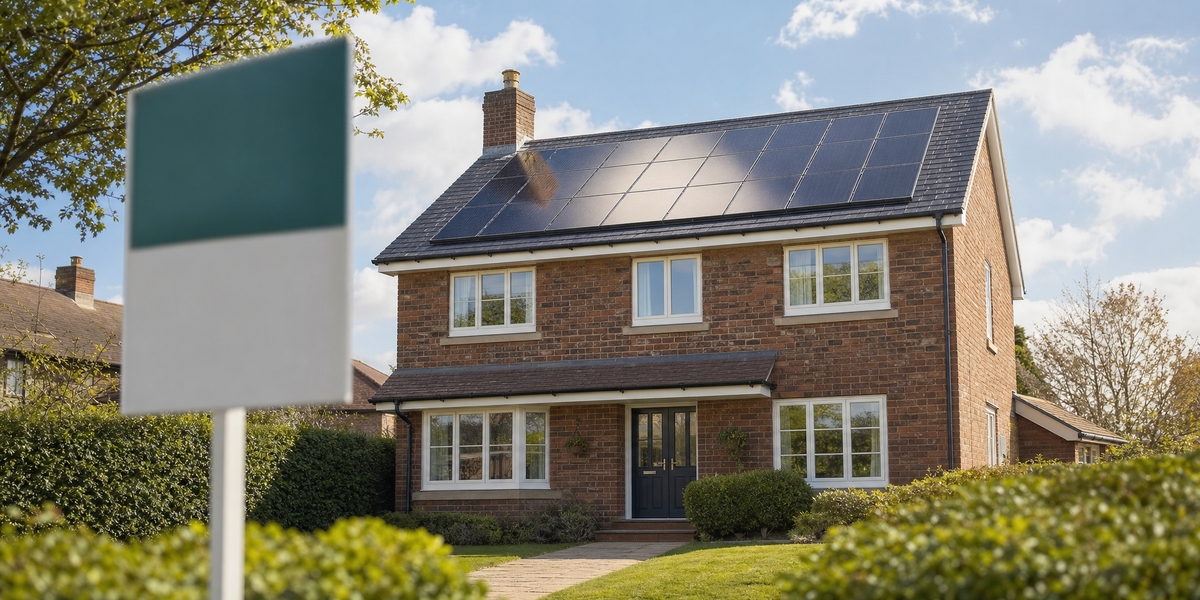
Buying a House With Solar Panels: What to Check Before You Exchange
Buying a House With Solar Panels: What to Check Before You Exchange
Here is something that catches people out with impressive regularity. You pay for a homebuyer survey, the surveyor walks the property, writes up the roof, notes that there are solar panels on it, and recommends you get them looked at by a specialist. That is the end of the surveyor's involvement. Nobody tests the system. Nobody reads the inverter's fault log, checks whether the array is generating what it should, or asks who owns the panels.
So you complete, move in, and inherit a piece of electrical generating equipment worth several thousand pounds, with no paperwork, no service history, no warranty you can name, and no idea whether it works.
We see the consequences constantly. A recurring theme in our enquiries is some version of the same sentence: the panels were already on the house when I bought it, and I have never had them checked. One caller this year had lived with her system for five years without knowing what it was. Another had a fourteen-panel array he had never once looked at. None of this is difficult to avoid. It just has to happen before you exchange, because afterwards your negotiating position is gone.
In summary: Before exchanging on a house with solar panels, establish three things. Does the seller own the panels outright, or is the roof leased to a third party? Is there a Feed-in Tariff, and will it transfer to you? And does the system actually work? Your homebuyer survey will not answer the third question.
Should I buy a house with solar panels?
Generally yes, and owned panels are a genuine asset. A working domestic array saves a typical UK home several hundred pounds a year and earns export income on top. With electricity prices staying stubbornly high, that saving is worth more now than it was when most of these systems went up. The problems are rarely with the idea of inherited solar. They are with leases, missing paperwork and systems nobody has maintained.
Think of it the way you would think of a boiler. Nobody refuses a house because it has a boiler. You would want to know its age, whether it has been serviced, and whether the paperwork exists. Solar deserves exactly the same treatment and gets it far less often, because it sits on the roof where nobody looks and makes no noise to complain about.
Are the panels owned, or is the roof leased?
This is the first question and by some distance the most important. Under a rent-a-roof scheme the homeowner never owned the panels. A third-party company paid for the installation, kept the Feed-in Tariff income, and leased the roof space, typically for 20 to 25 years. If that lease exists, you are buying a house with a commercial tenant on the roof.
These schemes were widespread between roughly 2010 and 2015, when Feed-in Tariff rates were high enough to make free installation profitable for the provider. Plenty are still running. The householder got cheaper daytime electricity, the provider got the tariff payments, and the arrangement was registered against the title.
Ask the estate agent the ownership question on the first viewing. Ask it again in writing through your solicitor. Sellers are not always clear on the answer themselves, particularly if they inherited the arrangement from a previous owner, and "I think we own them" is not a position to exchange contracts on.
Will solar panels affect my mortgage?
Owned panels almost never cause a problem. Leased ones frequently do. Lenders apply significantly more scrutiny where a third party holds a lease over part of the property, and some will not lend at all against a roof lease. Those that will generally require the lease to meet the conditions set out in the UK Finance Mortgage Lenders' Handbook.
The specific thing lenders care about is repossession. If they had to take the property back and sell it, could they? A lease that cannot be broken, or that binds the lender to a 25-year commercial agreement with a solar company, makes the property harder to sell and therefore riskier to lend against.
Where a lease is blocking a decent mortgage rate, buying it out is sometimes the answer. Buyout figures reported in the UK market commonly sit somewhere in the four to eight thousand pound range, though it depends entirely on the provider and the remaining term. Whether that is worth paying is a mortgage question rather than a solar one, and it belongs with your broker and solicitor. Get the lease document in front of them as early as you possibly can, because this is the single most common cause of a solar-related delay to completion.
What happens to the Feed-in Tariff when the house is sold?
Feed-in Tariff payments normally transfer with the property, but not automatically. Both parties have to complete a change of ownership application with the FiT licensee, supported by evidence that the installation was included in the sale. Miss that step and the payments can stop, or carry on going to the wrong person. Ofgem publishes guidance on the change of ownership process.
Some context on why this matters more than the amounts might suggest. The FiT scheme closed to new applicants on 1 April 2019, but installations accredited before then keep receiving payments for their full eligibility period, typically 20 years and up to 25 for the earliest, with rates adjusted annually by RPI. A system registered in 2012 on an early, generous tariff can still be producing a meaningful annual income in 2026, and will carry on into the 2030s. Our guide to keeping a legacy Feed-in Tariff system running covers what that income is worth protecting.
That income has value, and the seller is entitled to try to negotiate for it. There is no fixed formula. It is a matter for the purchase negotiation like anything else, so it is worth knowing roughly what the remaining payments are worth before you agree a price rather than afterwards. Ask which supplier administers the FiT, ask for a recent statement showing the tariff rate and annual payment, and make sure your solicitor has the change of ownership form on their completion checklist.
If there is no Feed-in Tariff, the system may instead be registered for the Smart Export Guarantee, which pays for exported surplus at rates set by individual suppliers. Those rates vary enormously, and as the new owner you are free to switch. Our guide to getting the best Smart Export Guarantee rate explains how to approach it once you have moved in.
The key takeaway: the legal and financial questions have deadlines attached and the technical one does not, which is exactly why the technical one gets skipped. Ownership, lease and tariff all have to be settled before exchange. Whether the system works is the question everyone leaves until the panels have been theirs for three years.
Which documents should I ask for before exchange?
Six documents cover it, and a seller with a properly installed, well-kept system should be able to produce most of them. Gaps are not automatically a dealbreaker. They do tell you something about how the system has been looked after, and they affect what you can claim later.
The MCS certificate. Proves competent installation to a recognised standard, and is required for Feed-in Tariff and Smart Export Guarantee payments. If it is missing, the MCS register holds a searchable copy.
DNO notification (G98 or G99). Confirms the grid operator was told the system exists. Unnotified systems can need retrospective approval.
The electrical installation certificate. Records that the AC side was tested and signed off at commissioning.
Panel and inverter warranties. Panels typically 25 years, inverters 10 to 12. Serial numbers let a manufacturer confirm what cover remains. Be aware that if the original installer has since closed, the workmanship guarantee behind the installation may no longer be enforceable. Our guide on what happens when a solar installer goes bust explains which protections survive and which do not.
The roof lease, if one exists. Determines whether you can get a mortgage. Non-negotiable. It must be found.
Service and repair history. Expect this one to be missing. Of the 55 homeowners who completed our online system check in the twelve months to August 2026, 28 told us their system had never been serviced at all.
What about the EPC and my buildings insurance?
Two smaller points that are easy to deal with early and irritating to deal with late.
Solar generation is factored into a property's Energy Performance Certificate, so a working array should be helping the rating. You can look up the current certificate on the government's Find an Energy Certificate service, which is a separate register from MCS and holds different information. If the EPC records solar but the system turns out to be faulty, the rating is flattering the property rather than describing it.
On insurance, most buildings policies cover solar panels as part of the structure, but you have to tell your insurer they are there. Undeclared installations are a common reason for a rejected claim after storm damage. Sort this at the same time as the rest of your moving-in admin, and keep any inspection report you commissioned, since insurers increasingly want evidence of maintenance rather than just a photograph of intact panels.
How do I know the system actually works?
You have it inspected, because nothing else in the buying process will tell you. A standard homebuyer survey covers the building. Surveyors will note that solar panels are present and may comment on the roof around them, but they do not carry out electrical testing of a PV system, read inverter fault logs, or verify generation against expected output. Most will explicitly recommend a specialist inspection, and most buyers never arrange one.
That gap matters because the components have very different lifespans. Panels degrade slowly, typically losing around half a percent of output a year, and are warrantied for around 25 years. The inverter is the hard-working part and typically lasts 10 to 15 years, with warranties running out at 10 or 12. If you are buying a house with a system installed during the 2011 to 2015 Feed-in Tariff boom, that inverter is somewhere between eleven and fifteen years old right now. Replacement runs roughly 700 to 1,500 pounds installed.
That is not a reason to walk away. It is a reason to know before you agree a price, because a system with a failing inverter and corroded mounting hardware is a legitimate negotiating point, and one you cannot raise after completion.
What does a pre-purchase solar inspection involve?
Our 21-point Solar MOT is the same inspection we carry out for existing owners, and it works well as a pre-purchase check. An MCS-certified engineer works through panels and array, electrical safety, inverter diagnostics, performance against expected output, protection and environment, and documentation. You get a written report with traffic-light grading the same day. If you want the full breakdown of what gets checked, our guide to what a Solar MOT covers goes through it point by point.
The traffic-light grading is the part that matters in a purchase. A report saying "Red: inverter showing recurring earth fault, replacement likely within 12 months" is something your solicitor can act on. A vague sense that the panels look a bit old is not.
Timing is the practical constraint. Book it alongside your survey rather than after it, and arrange access through the agent in the same conversation. Sellers are usually fine with it. A seller with a healthy system has every reason to want it documented, and one who resists has told you something useful.
What if I have already moved in?
Then you do the same thing, slightly later, and you have lost only the negotiating leverage. Everything else is still recoverable. Missing MCS certificates can usually be traced, FiT ownership can be transferred retrospectively, and an inspection tells you what condition the system is in whether you have owned it for three weeks or three years.
Start with the Feed-in Tariff if there is one, because that is money currently going somewhere. Contact the licensee, establish whose name the installation is registered in, and complete the change of ownership. People discover years later that payments have been going to a previous owner, and recovering that is considerably harder than preventing it. If you are unsure where you stand on any of the consumer protection questions, Citizens Advice is a useful free starting point.
Then get the system inspected, particularly if you have no idea when it was last looked at. On the Dorset or Hampshire coast, add salt corrosion and gull nesting to the list of things worth checking early, because within a couple of miles of the water both start showing up around year five to seven. In Cardiff, Newport, Swansea and the Valleys, higher rainfall means moss and lichen establish faster on a shallow-pitched array than most people expect, and mature street trees in older terraced areas throw shade that was not there on installation day.
Once you know what you have inherited, our ongoing care plans are the simplest way to make sure the system never drifts back into the state you found it in.
Book a pre-purchase inspection
Buying a house with solar? Find out what you are actually inheriting. Our 21-point Solar MOT covers panels, mounting, electrical safety, inverter diagnostics, real generation against expected output, and the documentation, with a written traffic-light report the same day, in time to use it.
If you would rather start with something quicker, our free 60-second solar health check gives you an initial read on a system before you commit to anything.
South Coast (Bournemouth, Poole, Christchurch, Southampton, Dorset and Hampshire): 01202 023069. South Wales (Cardiff, Newport, Swansea): 029 2002 6002. Or book online. MCS-certified engineers, rated 10/10 on Checkatrade, 500+ systems installed and inspected.
Frequently asked questions
Should I buy a house with solar panels?
Usually yes, if the panels are owned outright. A working system saves money and can carry Feed-in Tariff income. Take more care where the roof is leased to a third party under a rent-a-roof scheme, since some lenders decline those and others impose strict conditions on the lease terms.
Does a homebuyer survey check solar panels?
No. Standard surveys assess the building and will note that panels are present, but they do not include electrical testing of the PV system, inverter diagnostics or generation checks. Most surveyors recommend a specialist inspection. Arranging one is the buyer's responsibility.
Do solar panels affect getting a mortgage?
Owned panels rarely cause difficulty. Leased ones often do, because a third-party lease over the roof complicates repossession and resale. Lenders that accept them generally require the lease to meet the UK Finance Mortgage Lenders' Handbook conditions, including break rights.
Does the Feed-in Tariff transfer when I buy the house?
It normally transfers, but only if both parties complete a change of ownership application with the FiT licensee, evidencing that the installation was part of the sale. It is not automatic. Ask your solicitor to add it to the completion checklist.
How old is too old for inherited solar panels?
Panels stay productive well past 20 years, retaining roughly 80 to 90 percent of original output. The inverter is the limiting factor at 10 to 15 years. A 2012 system is likely due an inverter, which is a negotiating point rather than a reason to withdraw.
What if the seller has lost the MCS certificate?
It is usually recoverable. MCS operates a public register searchable by postcode, and the original installer can often reissue. You need it for Smart Export Guarantee payments and most warranty claims, so chase it during conveyancing rather than afterwards.
Who is responsible for solar panel repairs after I move in?
You are, unless a manufacturer warranty still applies or the panels are leased, in which case the lease sets out the provider's obligations. Installer workmanship warranties often do not transfer to a new owner, and are worthless if the company has closed. Our guide to what solar maintenance actually costs sets out what to budget once the system is yours.