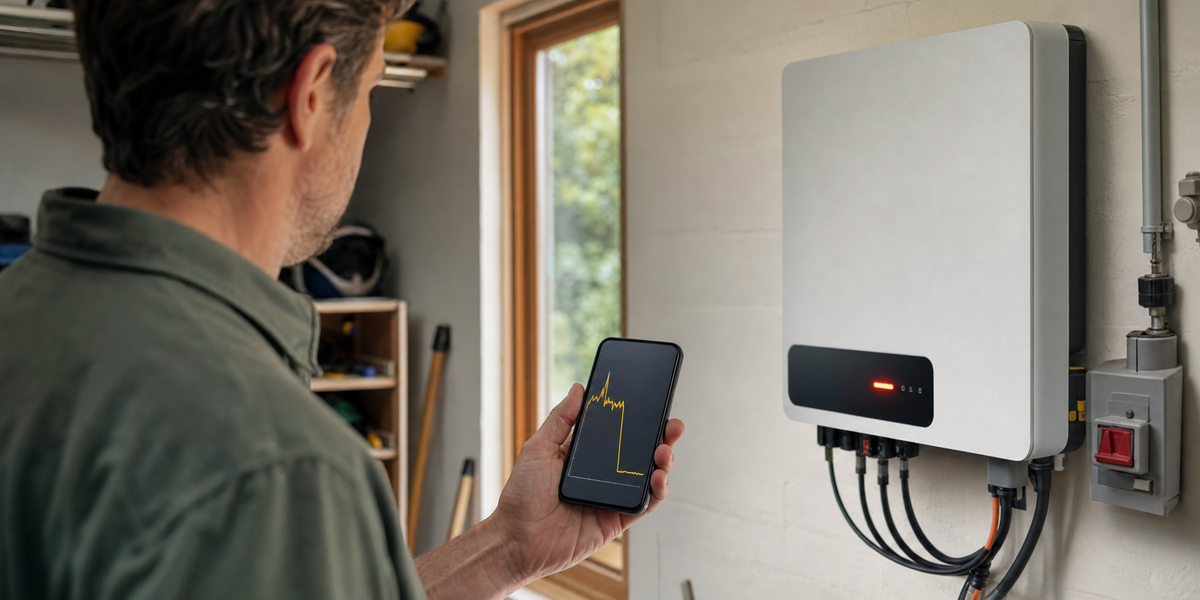
Solar Panel Not Working? Here is How to Diagnose the Problem
There are few things more frustrating than realising your solar panels have quietly stopped doing their job. Whether your generation meter has flatlined, your monitoring app is showing a drop in output, or your electricity bills have crept back up unexpectedly, a solar panel not working properly can cost you real money every day it goes unresolved. The good news is that many faults follow predictable patterns, and with a bit of systematic checking, you can often identify the problem before picking up the phone.
This guide covers the most common causes of solar panel failure, what you can safely check yourself, and when it makes sense to bring in a qualified professional. We work with homeowners across Bournemouth, Dorset, Hampshire and the wider South Coast, and we see the same types of faults come up time and again.
Start With Your Inverter
The inverter is the first place to look when your system stops generating power. It converts the direct current produced by your panels into the alternating current your home actually uses, and it acts as the nerve centre of the entire installation. Most modern inverters have a small display screen or status light, and a fault will usually trigger an error code or a flashing warning.
Common inverter error codes relate to grid connection issues, isolation faults or overheating. A red light or a code beginning with "F" or "E" typically indicates a fault rather than a warning. Check the display against the manual that came with your system. If you cannot find a physical copy, the manufacturer's website will usually have a PDF version available.
If the inverter display is completely blank and you have confirmed the power supply to it is live, the inverter itself may have failed. Inverters have a typical lifespan of ten to fifteen years, so if your system is approaching or past that age, this is a real possibility. Our blog on solar panel inverter problems and how to troubleshoot them goes into much more detail on this specific component.
Check Your Generation and Monitoring Data
Before assuming a complete failure, compare your current output figures against historical data. Most modern systems come with a monitoring app or an online portal where you can see generation figures by day, week or month. A sudden drop to zero is almost certainly a fault. A gradual decline over several months, however, may point to a different issue altogether, such as soiling, shading from a newly grown tree, or natural panel degradation over time.
According to the Energy Saving Trust, a well-maintained solar PV system should generate roughly what your original quote predicted across the year, adjusted for seasonal variation. If your figures are consistently twenty percent or more below what they should be, that is a strong signal something is wrong.
For older systems that may not have digital monitoring, you will need to read the generation meter directly and compare it against records you have kept or estimates based on your system size and location. Homeowners in the Bournemouth and South Coast area are actually in a strong position here, since this part of England benefits from above-average sunshine hours compared to much of the UK, as recorded by the Met Office. Lower-than-expected output is therefore harder to explain away by weather alone.
Solar Panel Not Working Due to Shading or Soiling
Not every problem is a component failure. Two of the most common reasons for reduced or zero output are shading and dirt, and both are easy to overlook because the panels themselves look fine from a distance.
Shading
Shading has a disproportionate effect on solar output, particularly in systems without microinverters or power optimisers. In a string inverter system, shading on just one panel can drag down the output of the entire string. Walk around your property and look at what might be casting a shadow across your roof at different times of day. Chimneys, TV aerials, satellite dishes, neighbouring trees and even new extensions on adjacent properties can all cause problems that were not there when your system was first installed.
Soiling and Debris
Dirt, bird droppings, moss and general grime build up on panel surfaces over time and block sunlight from reaching the cells underneath. Studies from Solar Energy UK suggest that heavily soiled panels can lose between fifteen and twenty-five percent of their output, sometimes more in coastal areas where salt residue from sea air compounds the problem. If you live near the coast in Dorset or Hampshire, this is particularly relevant to you. Our article on how salt air affects solar panels on the South Coast explains exactly what happens and what you can do about it.
You can visually inspect your panels from the ground using binoculars if the roof pitch makes it difficult to see clearly. Do not attempt to climb onto the roof yourself. Working at height carries serious risks and the Health and Safety Executive is clear that falls from height remain one of the leading causes of fatal workplace accidents in the UK. The same principle applies at home.
Tripped Breakers and Blown Fuses
Before assuming a major fault, check your consumer unit. Solar PV systems connect to your consumer unit through a dedicated circuit, and if a breaker has tripped or a fuse has blown, the system will stop exporting power entirely. This can happen after a power surge, a lightning strike or even just a coincidental fault elsewhere in your home's electrics.
Locate the solar PV circuit breaker in your consumer unit and check whether it is in the off position. If it is, reset it and monitor your generation figures for the next hour or two. If it trips again immediately or shortly after resetting, do not keep trying to reset it. A breaker that trips repeatedly is telling you there is an underlying fault that needs investigation by a qualified electrician or solar engineer.
Also check the DC isolator switch, which is typically located near the inverter and sometimes on the roof adjacent to the panels. This switch should be in the on position during daylight hours when the system is operating normally.
When Weather Is Not the Explanation
It is tempting to blame poor output on cloudy weather, but UK solar panels are designed to generate power even in overcast conditions, just at reduced levels. A completely flat generation reading on a bright summer day in Bournemouth is not a weather issue. Similarly, if your neighbours with comparable systems are generating normally and your system is not, the problem is almost certainly a fault rather than meteorological.
There are also some counterintuitive weather effects worth knowing about. Extremely hot weather can actually reduce output slightly because photovoltaic cells become less efficient at higher temperatures, a phenomenon explained in our article on whether solar panels work better in a heatwave. Conversely, cold and bright winter days can sometimes produce better output than expected.
Common Component Faults to Be Aware Of
Faulty Panels
Individual panels can develop faults over time through micro-cracking, delamination or cell degradation. These are often invisible to the naked eye but show up clearly on a thermal imaging camera, which a qualified engineer can use during an inspection. A panel with a hot spot or internal crack will underperform significantly and in some cases can create a safety risk if left unaddressed.
Wiring and Connection Problems
Connections between panels and between the array and the inverter can corrode or loosen, especially in exposed roof environments. Rodent damage to cabling is also more common than most people realise, particularly if your panels are mounted in a way that gives birds or animals access to the underside. Our article on birds nesting under solar panels covers this in more detail, including what protective measures are available.
Battery Storage Issues
If your system includes battery storage, a fault in the battery unit can prevent the system from operating correctly even when the panels themselves are fine. Battery management systems can throw error codes just like inverters, and the battery may need recalibration, firmware update or in some cases replacement.
What a Professional Inspection Covers
If you have worked through the basic checks above and still cannot identify the problem, or if you have found a fault but are not sure how serious it is, a professional inspection is the right next step. No1 Solar Care's Solar MOT service is designed exactly for this situation.
Our Solar MOT covers a full visual inspection of the panels and mounting system, electrical testing of the array, inverter diagnostics, check of all isolators and connections, generation performance analysis and a written report of findings. If we find a fault, we will explain it clearly and give you an honest assessment of what needs doing and why. For homeowners across the South Coast, from Bournemouth to Southampton and beyond, this kind of structured inspection often reveals issues that have been quietly costing money for months.
For context on what professional maintenance typically involves and costs across the UK, take a look at our guide on solar panel maintenance costs for UK homeowners.
If your system is registered under the old Feed-in Tariff scheme, a fault is not just an inconvenience, it could be affecting the payments you are entitled to receive. Ofgem oversees the Feed-in Tariff scheme and your obligation as a recipient is to keep the system in good working order. Equally, if you export energy under the Smart Export Guarantee, a non-functioning system means zero export payments until the fault is fixed.
Not sure where to start? Take our free 60-second solar health check to get an instant sense of whether your system might have an issue worth investigating.
When to Act Quickly
Some faults are low urgency, such as a dirty panel that needs cleaning or a minor shading issue. Others need prompt attention. If you notice any burning smell near the inverter, scorch marks on panels or cabling, or visible damage to panel surfaces after a storm, treat this as urgent. Our article on what to do after storm damage to solar panels is a useful reference if bad weather has recently affected your property.
Also contact your home insurer if you suspect storm damage, as solar panels are often covered under buildings insurance. The Citizens Advice website has useful guidance on making insurance claims if you are unsure of your rights.
The longer a fault goes unresolved, the more generation you lose and the higher the risk of secondary damage. A professional inspection from No1 Solar Care can typically identify the root cause quickly and give you a clear path forward.
Frequently Asked Questions
Why is my solar panel not working even though it is a sunny day?
A sunny day with no generation almost always points to a component fault rather than a weather issue. Start by checking your inverter display for error codes, then look at your consumer unit for a tripped breaker. If both look normal, you likely need a professional diagnostic inspection to identify the underlying cause.
Can I reset my solar inverter myself?
Yes, in most cases you can safely restart your inverter by switching off the AC isolator, waiting a couple of minutes, then switching it back on. Check your inverter manual for the exact procedure for your model. If the fault code returns after restarting, a qualified engineer should carry out further investigation rather than you repeating the reset.
How do I know if the problem is my inverter or my panels?
If your inverter display shows zero input voltage from the panels on a bright day, the fault is likely in the panels or cabling. If the inverter is showing panel input but not converting or exporting power, the inverter itself is the more likely culprit. A thorough Solar MOT uses electrical testing to pinpoint which component is at fault.
Could dirty panels really stop my system from working entirely?
Heavy soiling can reduce output significantly, but it rarely brings output to zero on its own. If your system has stopped generating completely, a component fault is the more likely explanation. That said, in coastal areas of Dorset and Hampshire, salt and grime build-up can be severe enough to cause surprisingly large output losses, so cleaning should be part of your regular maintenance routine.
How long should a solar panel system last before needing major repairs?
The panels themselves typically carry a performance warranty of twenty-five years and often last longer. Inverters usually need replacing after ten to fifteen years. Wiring and connections can develop faults earlier if the installation is exposed to harsh conditions, as is common on the South Coast. Regular inspections help catch problems before they become expensive.
Does a solar panel fault affect my Feed-in Tariff or Smart Export Guarantee payments?
Yes. If your system is not generating or exporting power due to a fault, you will not receive the payments you would otherwise be entitled to. Ofgem administers the Smart Export Guarantee and requires that systems function correctly. Getting faults resolved quickly minimises lost income as well as lost generation.
What does No1 Solar Care's Solar MOT include?
The Solar MOT service covers a full inspection of your panels, mounting system and all electrical components including the inverter, isolators and wiring. We carry out performance testing and provide a written report. It is designed to give Bournemouth and South Coast homeowners a clear picture of their system's health and identify any faults or risks that need attention.
Book your Solar MOT today. Call 01202 023069 or visit no1solarcare.co.uk/solar-mot